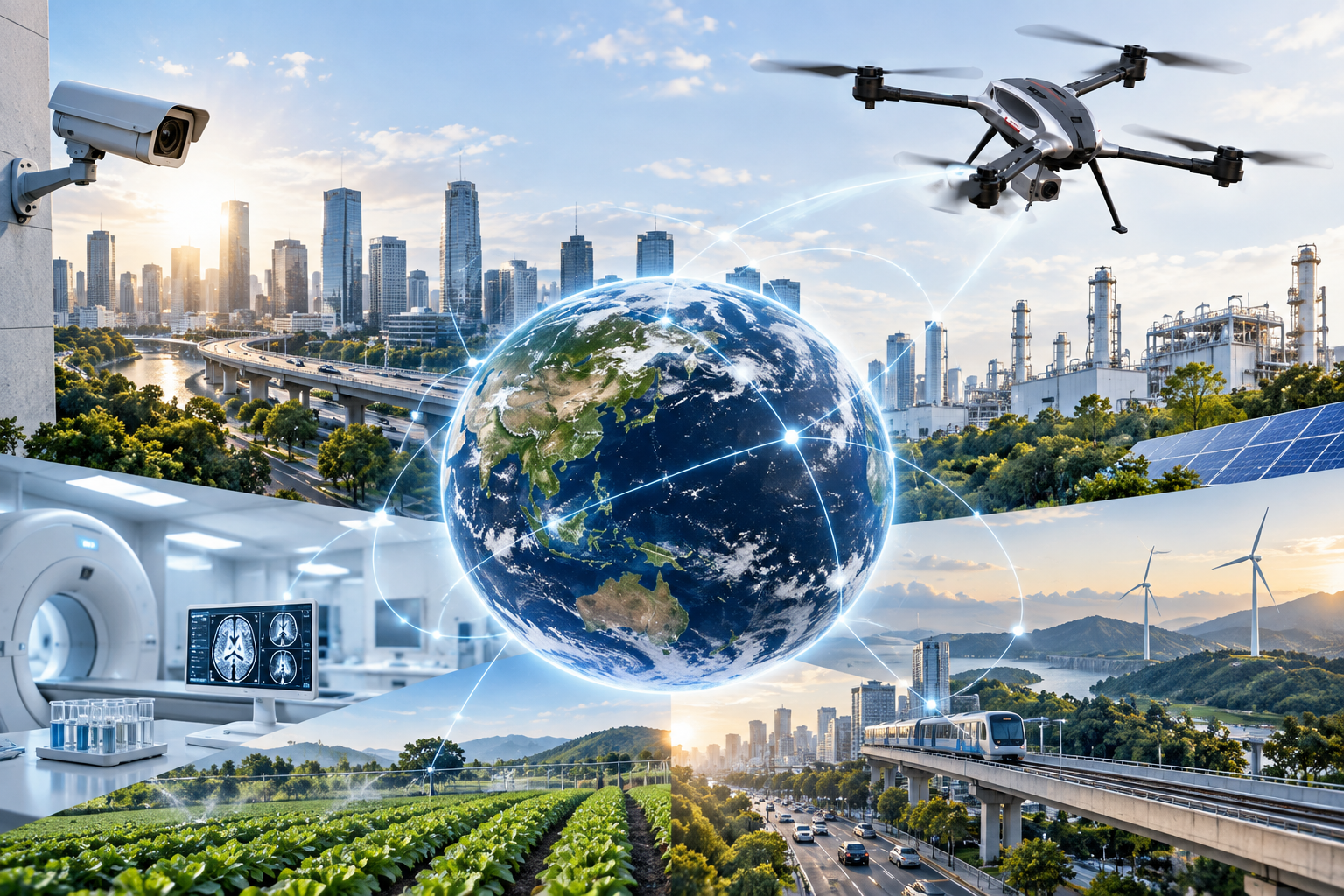
AI (Artificial Intelligence) is making the world smarter, faster, and safer: boosting the economy, increasing work productivity, enabling precise drug discovery and medicine, delivering personalized learning, managing energy and climate more efficiently, improving public safety, and opening up new spaces for creativity. At the same time, it brings serious challenges around ethics, privacy, and the future of work that must be managed responsibly.
What is AI and how does it work?
AI is a system that mimics human intelligence, such as visual/audio perception, language understanding, decision-making, and content creation (Generative AI).
Key technologies include:
- Machine Learning / Deep Learning: learning from large amounts of data to make predictions and decisions.
- Generative AI: generating text, images, audio, and code (used for content, design, and software development).
- Edge AI: running models on endpoint devices (phones, cameras, gateways) to reduce latency and enable offline operation.
- MLOps: processes for putting AI into real, sustainable production (versioning models and data, monitoring, and lifecycle management).
Why AI is important for the global economy
- Boosting productivity: automating repetitive steps so teams can work faster and reduce costs.
- More accurate decision-making: analyzing large-scale data to forecast sales, customer demand, and risk.
- New products and services: 24/7 customer-service chatbots, coding assistants, recommendation systems, and supply-chain analytics.
- Practical for SMEs: starting from back-office work—accounting, documents, inventory—through to digital marketing.
AI in healthcare and life sciences
- Faster diagnosis: analyzing X-rays, brain scans, and vital signs in near real time.
- Personalized medicine: predicting how patients will respond to drugs and reducing side effects.
- New drug discovery: accelerating the journey “from lab to clinic.”
- Remote and elderly care: Edge AI devices detecting falls and sending automatic alerts.
AI in education and lifelong learning
- Personal tutoring assistants: adapting difficulty levels to each learner.
- Content creation for teaching: auto-generating lesson plans, exercises, and tests.
- Analyzing student engagement: helping teachers spot learning bottlenecks and intervene quickly.
AI for environment, energy, and smart cities
- Smart energy: forecasting electricity demand and managing batteries/renewable energy sources.
- Precision agriculture: checking crop health, detecting diseases/pests, and managing water and fertilizers.
- Air quality and disasters: forecasting PM2.5, floods, wildfires, and sending hyperlocal alerts.
- Intelligent traffic: adjusting traffic lights and managing accident-prone areas using Vision AI.
Public safety and disaster management
- Real-time risk detection: smoke and fire, rising water levels, intrusions into hazardous areas.
- Intelligent command centers: integrating signals from cameras and sensors, prioritizing incidents (triage), and dispatching response teams faster.
- Offline operation: Edge AI keeps detecting and alerting even when the network goes down.
Creativity, media, and the creator economy
- Faster content production: scripts, articles, designs, and campaign ideas.
- Local and multilingual campaigns: translating/summarizing/condensing content to communicate across markets.
- Solo creators can do it all: video, music, and podcasts powered by Generative AI tools.
Impact on jobs and future skills
- Repetitive tasks will be automated → people move toward more complex, higher-value work.
- Key skills to build:
- Prompting & tool usage
- Data literacy
- Automation thinking
- Critical thinking
- Ethics
- Organizational approaches: reskill/upskill programs, human-in-the-loop workflows, and measuring outcomes by results—not hours worked.
Ethics, privacy, and rules of the game
- Model fairness and bias: detecting and reducing bias in AI systems.
- Privacy (Privacy/PDPA): collecting only what is necessary and using on-device processing when possible.
- Transparency and auditability: explainable models and robust audit logs.
- Cybersecurity: protecting data and models from attacks and misuse.
In public safety, AI's value lies in helping people make informed decisions with relevant context. Designed around this context, an Integrated Operation Center (IOC) links incident information with responsible personnel through clear review and handover steps.
How to start using AI effectively in your organization
- Start with measurable problems: customer service, document workflows, demand forecasting, quality control (QC), safety.
- Choose the right architecture: Edge-first + Cloud-assist for real-time and offline-critical use cases.
- Define KPIs: latency, accuracy/recall, time-to-alert, time/cost savings, customer satisfaction.
- Set up governance: PDPA/privacy, model registry, data versioning, access control.
- Run a 90-day pilot → then scale step by step (team by team, site by site) with MLOps in place for long-term maintenance.
AI matters to the world because it helps improve quality of life (health, education, safety), drive the economy and innovation, and manage resources and the environment more intelligently, while demanding strong responsibility in ethics and privacy.
If planned and governed correctly, AI will become a core piece of the intelligent infrastructure of the modern world.