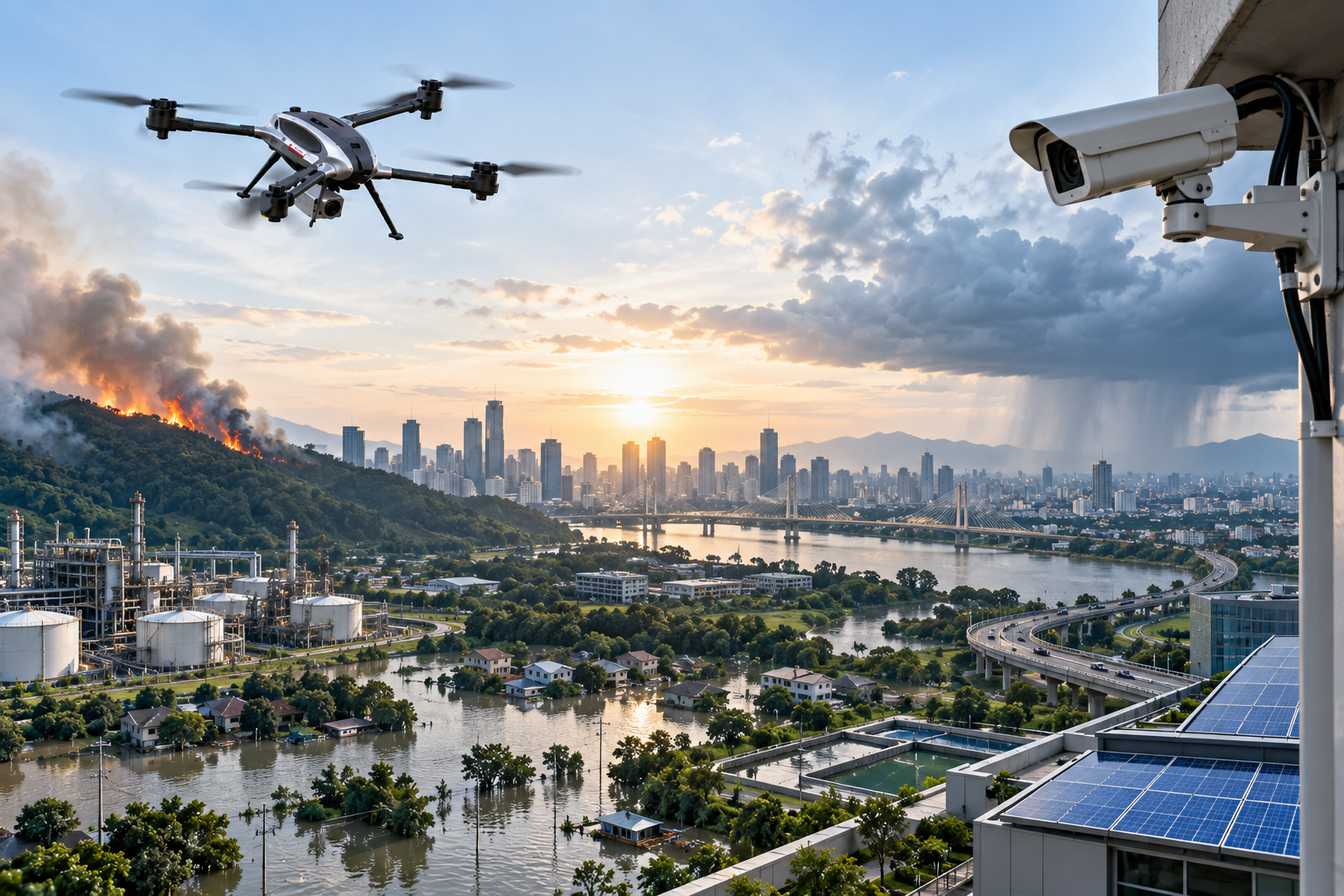
In an era of record-breaking floods, extreme heat, storms, industrial accidents and cascading supply-chain disruptions, disaster risk is no longer “just” a government issue. It directly shapes business continuity, investor confidence, insurance costs and even brand trust.
At the center of global efforts to reduce these risks is the United Nations Office for Disaster Risk Reduction (UNDRR) – the UN system’s focal point for disaster risk reduction (DRR) and the custodian of the Sendai Framework for Disaster Risk Reduction 2015–2030.
This article gives a practical overview of UNDRR and the Sendai Framework, then connects these ideas to how technologies like Canal One’s ASAP (All Smart AI Platform) can help governments, industrial estates and enterprises turn global DRR principles into everyday operational systems.
What is UNDRR?
The United Nations Office for Disaster Risk Reduction (UNDRR) is:
- A Secretariat office of the United Nations, created in December 1999
- The designated focal point in the UN system for coordinating disaster risk reduction
- The custodian of the Sendai Framework for Disaster Risk Reduction 2015–2030, supporting countries in its implementation, monitoring and review
UNDRR:
- Coordinates international efforts in DRR
- Guides and reports on countries’ progress towards the Sendai Framework’s goals
- Convenes the Global Platform for Disaster Risk Reduction, a major global forum for policy, practice and innovation
The Sendai Framework 2015–2030 in a Nutshell
Adopted at the Third UN World Conference on Disaster Risk Reduction in Sendai, Japan, the Sendai Framework for Disaster Risk Reduction 2015–2030 is the world’s main agreement for managing disaster risk.
It is a 15-year, voluntary, non-binding framework that recognizes that:
- States have the primary role in reducing disaster risk
- But responsibilities are shared with local governments, the private sector, civil society and other stakeholders
The overall goal
The Sendai Framework aims at:
“The substantial reduction of disaster risk and losses in lives, livelihoods and health and in the economic, physical, social, cultural and environmental assets of persons, businesses, communities and countries.”
To drive this, it defines seven global targets (A–G) and four Priorities for Action.
The four Priorities for Action
- Understanding disaster risk
Develop high-quality data and analytics on hazards, exposure, vulnerability and capacity – not just for past events, but for future scenarios too. - Strengthening disaster risk governancePut in place clear policies, legal frameworks, roles and coordination mechanisms at all levels of government and across sectors.
- Investing in disaster risk reduction for resilienceShift investments towards prevention and reduction of risk – from resilient infrastructure and early warning systems to data platforms and digital monitoring tools.
- Enhancing disaster preparedness for effective response and ‘Build Back Better’Improve preparedness and response capacity, and when disasters do occur, rebuild in ways that make systems safer and more resilient than before.
How UNDRR Helps Countries, Cities and Businesses
UNDRR’s work goes far beyond reports and conferences. It:
- Guides, monitors and analyses global progress on implementing the Sendai Framework
- Maintains the Sendai Framework Monitor, an online tool that helps countries track disaster losses, report on global targets and link with SDG indicators
- Provides technical support to governments, regional bodies and stakeholders in developing risk-informed strategies and policies
- Supports initiatives such as Making Cities Resilient 2030 (MCR2030), where hundreds of cities develop and implement DRR strategies and resilience plans
By October 2024, 163 countries (about 84% of all countries) had reported on the Sendai targets through the Sendai Framework Monitor, and over 600 local governments were implementing or developing DRR strategies.
This is the policy “backbone” that many national disaster management laws, city risk strategies and sector regulations—especially in infrastructure, energy, logistics and industrial safety—are now aligning with.
Why UNDRR and DRR Matter for Asia-Pacific Businesses
Asia and the Pacific is widely recognized as the most disaster-prone region in the world, with millions of lives lost to disasters since 1970 and a high share of global disaster events.
ecent UN and WMO reports show that:
- Asia remains the world’s most disaster-hit region from weather, climate and water-related hazards
- Floods, storms and climate-related extremes are increasing in frequency and severity
For Thailand and ASEAN economies, this has direct implications:
- Industrial estates, ports, airports and logistics hubs face growing physical and operational risk
- Cities need to protect people while keeping services, mobility and commerce running
- Corporates must ensure business continuity, compliance and ESG performance under increasing scrutiny
This is exactly where UNDRR’s principles and the Sendai Framework intersect with technology-led, data-driven risk management.
Four UNDRR-Inspired Ideas Organizations Can Apply Now
1. Turn “risk” into visible, real-time data
Priority 1 of the Sendai Framework stresses understanding risk through robust data and analytics.
or an organization, that can mean:
- Mapping multi-hazard risks across facilities and campuses (fire, floods, hazardous materials, intrusions, unsafe behavior)
- Integrating feeds from CCTV, sensors, IoT devices, access control, environment monitors and weather data
- Using AI for anomaly detection – for example, detecting smoke and fire, PPE violations, falls, intrusions, suspicious objects, or abnormal behavior patterns, in real time
Canal One’s ASAP (All Smart AI Platform) is specifically designed to sit on top of existing equipment and boost its intelligence, making it easier to analyze, differentiate and detect abnormal situations across Safety, Security and Environment domains.
2. Build clear governance and compliance around safety and DRR
Priority 2 is about strengthening disaster risk governance – clarifying roles, responsibilities and coordination.
In a practical enterprise context, this means:
- Defining end-to-end Standard Operating Procedures (SOPs) for different incident types
- Assigning clear owners and response time expectations for each step
- Embedding governance into digital workflows, alerts and approval chains
Here, technologies like ASAP can support AI-powered Compliance Monitoring and Automated Incident Response:
- AI checks if people follow rules (e.g., wearing PPE, keeping safe distances, respecting restricted zones)
- The platform can propose and trigger adaptive SOPs based on real-world conditions, instead of rigid one-size-fits-all rules
- Automated compliance reports and audit trails are generated for internal and external inspections
This aligns strongly with UNDRR’s emphasis on risk governance and with global standards like ISO 27001, NIST and other frameworks that many organizations must comply with.
3. Invest in prevention technology, not just response capacity
Priority 3 of the Sendai Framework calls for investing in disaster risk reduction for resilience, not just investing after disasters hit.
For smart cities, critical infrastructure and industrial operators, that can include:
- AI-based Safety & Security detection (smoke/fire, fall detection, intruder detection, suspicious objects, path tracking) to identify incidents early
- IoT & Smart Integration to connect CCTV, PA systems, drones, robots and environmental sensors into a Unified Security System that covers both cyber and physical domains
- Green Tech approaches like AI-optimized energy usage in video and sensor infrastructure to reduce cost and environmental impact at the same time
Canal One’s positioning is to orchestrate AI and IoT so that technology makes people safer, businesses smarter, and environments more responsive – exactly the kind of risk-aware, multi-hazard approach encouraged by UNDRR.
Applying UNDRR principles should bring risk information to those responsible for preparedness and response coordination. An Integrated Operation Center (IOC) developed as a Smart IOC should connect this information with team verification and coordination, so awareness leads to an appropriate next action.
4. Prepare, test and “build back better” using real data
Priority 4 stresses disaster preparedness and “Build Back Better” in recovery.
Organizations can move toward this by:
- Using historical incident and near-miss data from platforms like ASAP to understand:
- Where false alarms happen most
- Which locations have slower response times
- Which teams consistently miss SOP steps
- Designing drills and training around real risk patterns, not generic checklists
- After a major incident, using logged data (video, sensor data, AI insights and response timelines) to redesign layouts, SOPs and systems so that the rebuilt environment is safer and more resilient than before
This is where DRR becomes a continuous, data-driven improvement loop rather than a one-time plan on paper.
Canal One & ASAP Platform: From Global DRR Principles to On-the-Ground Systems
UNDRR and the Sendai Framework provide the policy and governance compass. Canal One’s role is to help cities, infrastructure operators and enterprises turn that compass into an operational system through:
- ASAP (All Smart AI Platform) – an AI management layer that works with existing equipment to detect anomalies, trigger alerts and support real-time decision-making under the Safety, Security & Environment concept
- AI Security & Safety and Unified Security Systems that connect cameras, drones, robots, radios and sensors into a single operational view for control rooms and field teams
- Compliance Monitoring and Automated Incident Response that help organizations keep up with both internal policies and external regulations, while reducing manual workload for safety, security and EHS teams
- Smart Integration & Green Tech – leveraging edge AI, energy-efficient processing and environmental monitoring (e.g., air quality, PM2.5, water level, temperature) to support climate resilience and sustainability goals alongside DRR.
UNDRR sets the global standard.Canal One and ASAP help you implement it – across facilities, cities and critical operations.