





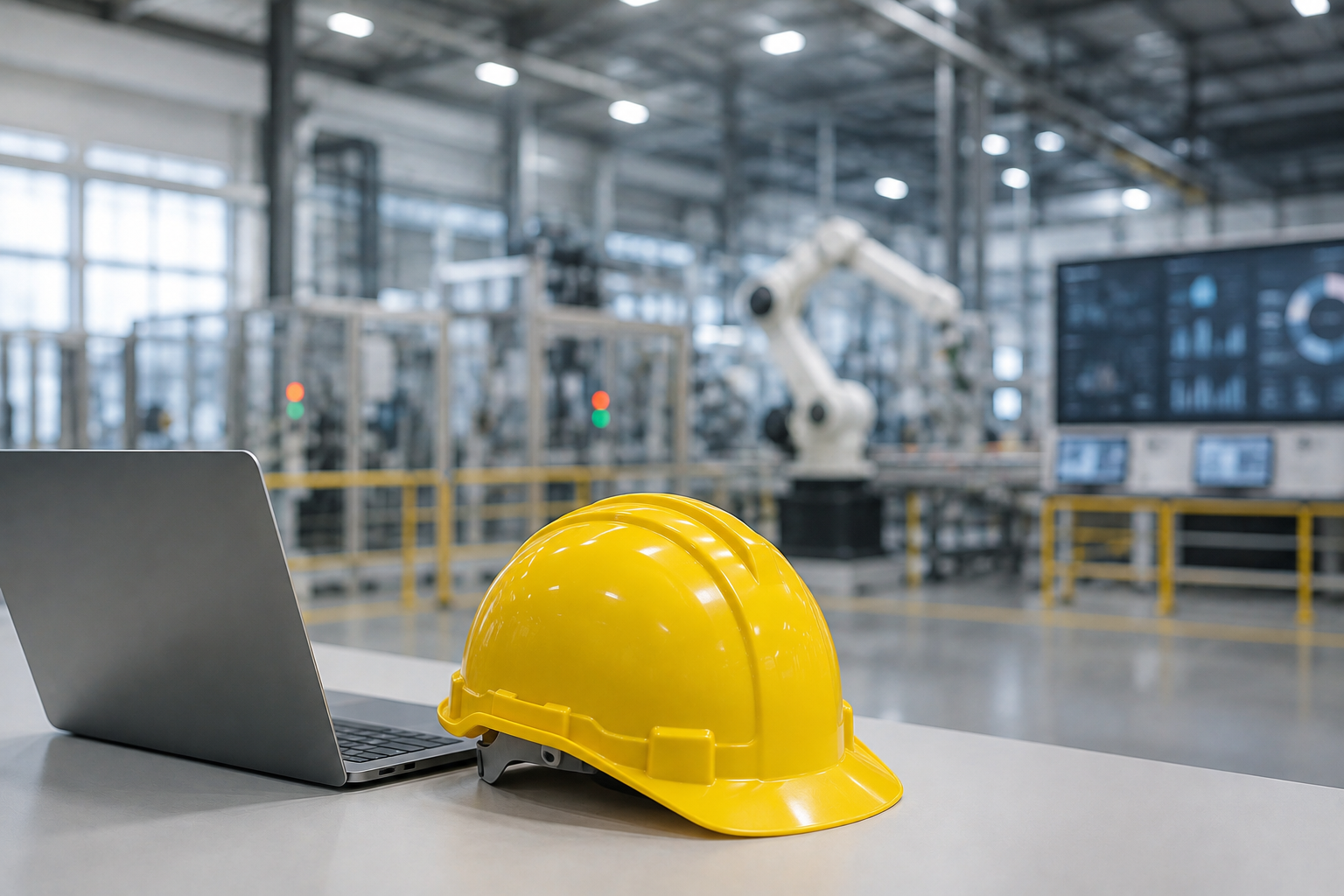
A Smart Factory is an intelligent manufacturing environment that connects technologies such as AI, IoT, sensors, CCTV cameras, and automation with operational processes. This enables factories to monitor, analyze, detect, alert, and respond to situations faster and more accurately.
But today, a Smart Factory is no longer simply a factory where machines operate automatically.
The real value lies in enabling people, data, devices, and systems to work intelligently together from production lines to safety, security, environmental monitoring, and factory operations.
One of the key technologies making this possible is Artificial Intelligence (AI).
A Smart Factory is a manufacturing environment that uses data from connected devices and systems to improve monitoring, analysis, decision-making, and operational efficiency.
Consider a conventional factory:
CCTV cameras record video.
Sensors collect data.
Fire alarm systems detect potential emergencies.
Security personnel monitor screens.
Safety teams check whether employees comply with workplace requirements.
The challenge is that these systems may operate separately, while many monitoring tasks still depend heavily on human operators.
A Smart Factory is therefore not simply about installing more equipment. It is about enabling different sources of data to connect, communicate, and support faster responses.
This is where AI becomes increasingly important.
AI transforms systems from simply collecting data into systems capable of understanding and analyzing data.
CCTV is a good example.
Traditional CCTV systems primarily record footage for personnel to monitor or review later. When AI is integrated, however, video and data from connected devices can be analyzed to identify predefined abnormal situations and trigger alerts more quickly.
In a factory environment, AI can be applied to areas such as:
This highlights an important distinction between having individual “smart devices” and building a truly intelligent factory ecosystem.
The key reason is not simply that AI is a new technology.
Factories generate enormous amounts of data and operational events every day.
People cannot continuously monitor every camera, check every sensor, and track every event simultaneously, 24/7, without the possibility of delays or human error.
Traditional monitoring, recording, and alert systems that rely heavily on personnel may therefore face limitations.
AI can support human operators by continuously analyzing large volumes of information and identifying events that require attention.
The goal is not to use AI to replace people.
Instead, AI should enhance human capabilities, helping people work faster, make better-informed decisions, and create safer operations.
Safety is one of the clearest areas where AI can create value in a Smart Factory.
Imagine an area where every employee is required to wear a safety helmet and appropriate PPE before entering.
If the process depends entirely on manual inspection, there may be moments when compliance cannot be checked consistently.
AI can work with camera systems to help monitor predefined conditions and send alerts when an event requires further attention.
This approach can be applied to PPE Safety, Smoke and Fire AI Detection, and other workplace safety scenarios.
Instead of requiring personnel to continuously watch every screen, AI can help direct their attention toward events that need immediate review.
Many factories already have CCTV cameras.
But there is an important question:
Are those cameras helping prevent incidents or simply recording what has already happened?
With AI-powered video analytics, camera data can be used to detect predefined events such as:
When an event is detected, the system can send a real-time notification through the appropriate communication channel, allowing responsible personnel to investigate and respond more quickly.
The value of a Smart Factory therefore does not come from simply having more cameras.
It comes from the ability to turn camera data into actionable information faster.
Factories are not only responsible for productivity. They must also operate according to regulations, SOPs, workplace rules, and safety standards.
This is where AI-Powered Compliance Monitoring can play an important role.
AI can help monitor operational conditions defined by an organization, such as PPE requirements or specific rules for restricted areas.
The resulting data can support compliance monitoring and reporting processes.
Instead of waiting for an incident to occur and reviewing it afterward, a Smart Factory can use data to identify potential areas of risk and continuously improve operational processes.
One common misconception about Smart Factories is:
“We need to replace all our existing equipment before we can become a Smart Factory.”
That is not necessarily the case.
Smart Factory transformation can begin with infrastructure that an organization already has.
Existing CCTV cameras, sensors, fire alarm systems, and notification systems may be integrated with management platforms and AI where technically appropriate.
This allows factories to gradually transition toward smarter operations by addressing high-priority pain points first, rather than replacing every system at once.
A more advanced Smart Factory should not stop at telling operators:
“Something unusual has happened.”
It should also help organizations determine what needs to happen next.
When a system detects an incident, the response process can be connected to the organization's SOPs to create a clearer sequence of actions.
Where automation is supported, some responses can be extended to connected devices. For example, a drone could be deployed to an incident location to provide additional situational information to operators.
The process can therefore evolve into:
Detect → Alert → Analyze → Respond
rather than stopping at:
Detect → Record
Another important dimension of a Smart Factory is environmental management and efficient resource utilization.
When sensors, IoT devices, and AI work together, factories can monitor environmental conditions such as:
Real-time data gives organizations greater visibility into changing conditions and can support analysis aimed at improving energy usage and operational processes.
A Smart Factory is therefore not only about automation. It can also become part of an organization's broader approach to Green Tech and data-driven environmental management.
An effective Smart Factory typically connects several important components.
1. Sensors & Connected Devices
Devices that collect information from the physical environment, including CCTV cameras, sensors, and IoT devices.
2. Data
Information generated by devices and operational systems that provides the foundation for analysis.
3. AI & Analytics
Technology that helps analyze data, identify abnormalities, and detect patterns that may be difficult for people to monitor continuously.
4. Real-Time Monitoring
Systems that allow relevant personnel to monitor situations and operational events more quickly.
5. Smart Integration
The ability to connect different devices and systems so they can work together instead of operating as isolated solutions.
6. Incident Response & Automation
The ability to turn information and alerts into responses based on appropriate SOPs or automation workflows.
A Smart Factory is therefore not a single product.
It is an ecosystem where People + Data + AI + Devices work together.
For Canal One, the Smart Factory concept is closely connected to ASAP All Smart AI Platform.
ASAP is a management platform that enables AI to work alongside existing operational equipment, enhancing the ability to analyze, differentiate, detect abnormal situation trends, and provide alerts.
Its capabilities are structured around three key areas:
Safety - Security - Environment
Applications that can be relevant to factory environments include Smoke and Fire AI Detection, PPE Safety, Intruder Detection, Suspicious Object Detection, Staff Counting, Energy Management, Water Level Monitoring, Air Quality Monitoring, and Temperature Monitoring.
Users can also monitor events across different devices and receive real-time notifications through appropriate communication channels.
For organizations requiring a higher level of automation, ASAP+ can extend the response process for example, by automatically deploying a drone to an incident location.
The important idea is that an organization does not necessarily need to discard its existing systems to begin its Smart Factory journey.
Canal One starts by analyzing user problems and requirements, then designs and customizes solutions to integrate with existing infrastructure wherever appropriate.
Ultimately, a Smart Factory should not be viewed simply as a factory with “no people.”
An intelligent factory allows people to spend less time manually monitoring tasks that technology can help perform continuously.
AI helps monitor and analyze.
Sensors collect data.
Connected systems deliver alerts.
Automation supports predefined response processes.
People remain responsible for defining objectives, designing workflows, evaluating situations, and making critical decisions.
This reflects Canal One's human-first technology approach: intelligent systems should help make people safer, businesses smarter, and environments more responsive.
A Smart Factory is a manufacturing environment that connects technologies such as AI, IoT, sensors, CCTV, data, and automation with operational processes. These technologies help factories monitor, analyze, detect, alert, and respond to situations more efficiently.
AI can be applied to areas such as smoke and fire detection, PPE monitoring, intruder detection, CCTV video analytics, air quality monitoring, temperature monitoring, water level monitoring, and operational risk analysis.
Not necessarily. Smart Factory transformation can begin by integrating AI and intelligent management systems with compatible existing infrastructure and equipment. Organizations can then expand their capabilities based on operational priorities and pain points.
AI can continuously analyze information from cameras and sensors, detect events based on predefined conditions, and provide real-time alerts to responsible personnel. This can reduce the burden of continuous manual monitoring and support faster incident response.
Yes. AI vision systems can work with cameras to help identify whether PPE requirements are being followed according to predefined conditions and alert personnel when an event requires further investigation.
ASAP, or All Smart AI Platform, is Canal One's management platform that enables AI to work alongside existing equipment and systems. It supports the analysis, detection, and notification of situations across Safety, Security, and Environment applications.
A factory should begin with the business or operational pain point that creates the greatest impact.
This could include workplace safety, PPE compliance, area surveillance, slow incident notification, environmental monitoring, or energy management.
The next step is to assess existing data and infrastructure, determine which AI or integration capabilities are appropriate, and gradually expand the system based on measurable needs.
In a smart factory, safety information from different areas should help production and site teams coordinate. Designed around this context, an Integrated Operation Center (IOC) links incident information with responsible personnel through clear review and handover steps.
Building a Smart Factory does not need to begin with a massive technology project.
A more important starting point is asking:
What problem is the factory trying to solve?
If personnel are monitoring too many CCTV feeds, AI can help identify events that require attention.
If PPE compliance is a challenge, Compliance Monitoring can help strengthen oversight.
If safety systems operate separately, Smart Integration can help connect information.
If incident response is too slow, Automation and SOP Integration can become the next step.
Because the goal of a Smart Factory is not to have the most technology.
The goal is to create a factory that is safer, smarter to operate, and more responsive to changing situations.
Canal One AI and IoT Orchestration for Safety, Intelligence, and Seamless Innovation.




We’re ready to help your team take the next step in safety, sustainability, and smart operations.