





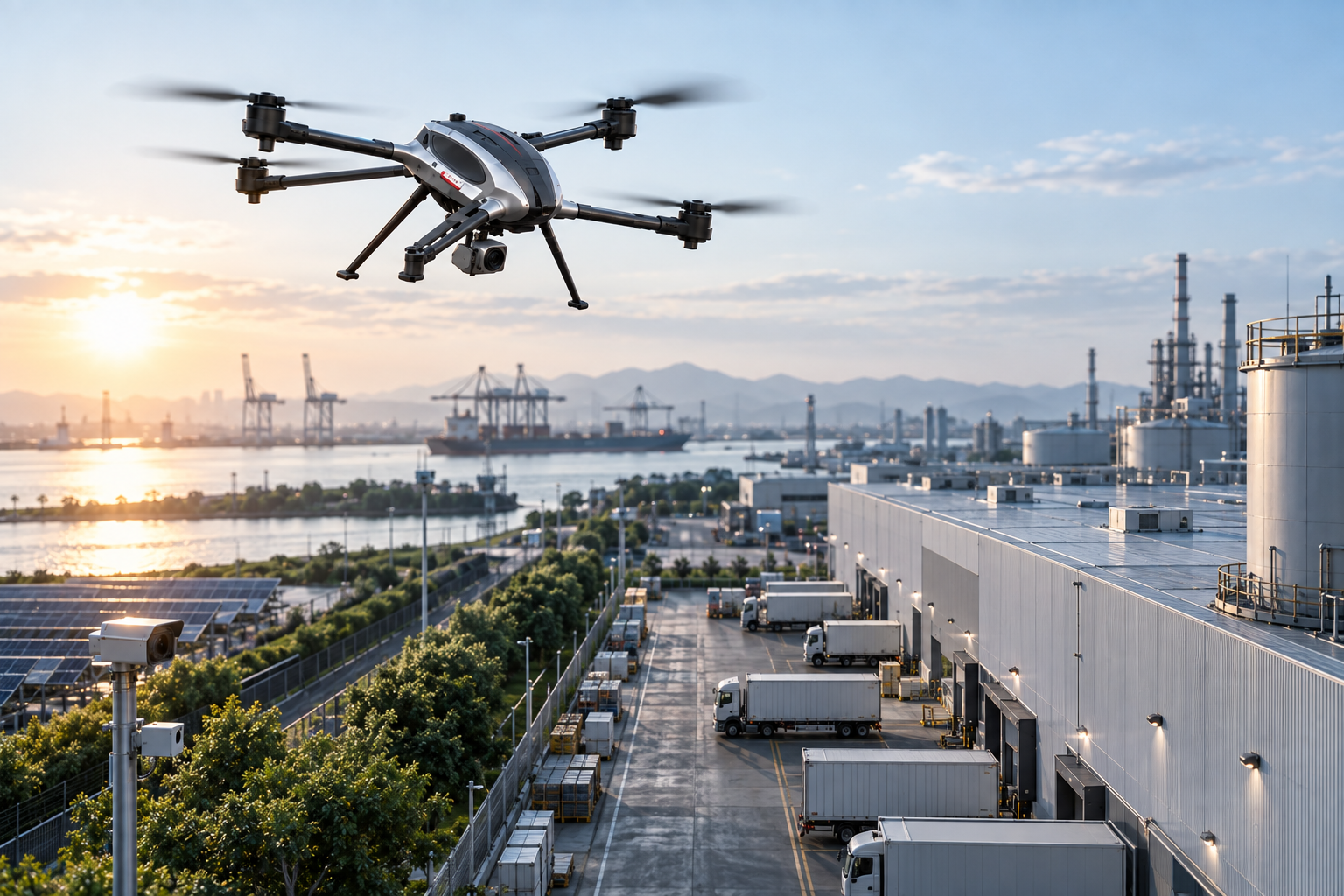
In many organizations, security costs go far beyond personnel expenses and equipment investment. They also include hidden costs such as delayed surveillance, human error, damage caused by unexpected incidents, and post-incident expenses that are often far higher than the cost of prevention.
This is why many businesses are turning their attention to smart drones as a key tool in modern security systems. Drones are no longer used only for aerial patrols. They can now become part of an AI Security & Safety ecosystem that enables organizations to monitor faster, respond more accurately, and manage costs more effectively over the long term.
At Canal One, this concept goes beyond using drones as standalone devices. Instead, drones are integrated with the ASAP Platform and a Unified Security System so that detection, alerting, and incident response work together as one continuous system.
When people think about security costs, they often think of direct expenses such as security guard wages, CCTV systems, or maintenance fees. In reality, organizations also carry many additional costs, including:
The larger, more complex, or higher-risk the environment is—such as factories, warehouses, industrial estates, public spaces, or critical infrastructure—the greater these costs become.
One of the major costs in security operations is the manpower required for routine patrols, especially across large sites or multi-zone facilities. Smart drones help reduce repetitive workloads significantly.
Drones can fly along pre-programmed routes, inspect high-risk areas, monitor blind spots, and access locations that are difficult for personnel to patrol on foot. This allows security staff to shift from constant patrolling to more valuable roles such as analysis and decision-making during incidents.
As a result, organizations can use human resources more efficiently without always having to increase headcount as the site expands.
Many losses do not come only from the incident itself, but from delayed awareness, delayed arrival at the scene, or delayed assessment.
Smart drones allow security teams to see live conditions on-site in real time, whether the issue involves intrusion, smoke, unusual activity, or incidents in areas that are difficult for people to access quickly. When connected to an automated alert system, organizations can detect events earlier and reduce the chance that a small issue escalates into major damage.
From a cost perspective, this directly reduces post-incident expenses such as repair costs, downtime, and disruption to business continuity.
Traditional security systems rely heavily on human observation, which naturally comes with limitations such as fatigue, routine blindness, missed details, or communication errors.
Smart drones working with AI can continuously detect abnormalities and send data back to the control center. This means surveillance no longer depends solely on human readiness.
When integrated with Canal One’s event analysis system through the ASAP Platform, organizations do not just “see” incidents more clearly—they can also understand risks better and respond according to SOPs more quickly.
Another cost that is often overlooked is the risk faced by personnel who must enter dangerous areas, such as elevated zones, isolated spaces, dark environments, after-hours locations, or areas where fire, smoke, chemicals, or abnormal events may already be present.
Deploying drones for initial inspection reduces the need for personnel to face those risks directly. This helps lower the chance of accidents and reduces long-term costs related to staff safety.
This reflects a genuine use of technology for Safety, Security & Environment.
Many organizations worry that investing in new technology means replacing their entire infrastructure, which can drive up initial costs unnecessarily.
Canal One’s approach is to design new technologies that work with existing systems through Smart Integration and multi-platform connectivity, whether with CCTV, sensors, alarm systems, radios, or other IoT devices.
Once smart drones become part of the overall system, organizations do not need to make redundant investments. Instead, they can build on their current infrastructure and make it smarter immediately.
The most important point is that drones deliver the highest value when they are not used as standalone tools.
If an organization uses drones only for occasional aerial viewing, the results may not reach their full potential. But when drones are integrated into a complete workflow, such as:
Then the drone becomes more than just a flying device. It becomes a decision accelerator that reduces time, losses, and operating costs at the same time.
The value of smart drones should not be measured only by purchase price. It should be evaluated through long-term impact, such as:
When organizations have better data, faster visibility, and more connected response workflows, the cost savings go beyond labor alone. They also reduce the cost of uncertainty that was once difficult to control.
Smart drones are especially suitable for organizations with large spaces, multiple risk points, or the need for continuous monitoring, such as:
Canal One also emphasizes designing solutions based on each organization’s specific context rather than offering a one-size-fits-all technology. Real cost reduction starts with understanding the user’s true pain points.
What makes Canal One different is not just the availability of smart drones or AI detection, but the ability to connect every element into a Unified Security System that brings together physical security, data, operations, and follow-up processes within one platform.
This approach allows organizations to avoid managing multiple disconnected tools and to move from passive monitoring toward proactive risk management.
When combined with the ASAP Platform, which supports real-time alerts, compatibility with existing devices, multi-device operations, and user-friendly system design, organizations can see clearer results in both operational efficiency and cost optimization.
Smart drones can reduce long-term security costs because they do more than simply replace manual patrols. They help minimize losses, reduce human error, improve response speed, and connect critical data into a smarter security management system.
For organizations looking for more than conventional surveillance, using smart drones together with AI and an integrated platform is an investment that transforms security costs from a fixed expense into a controllable and optimizable asset.
That is the direction of Canal One—developing technology that makes people safer, businesses smarter, and environments more responsive through seamless, practical, and human-centered solutions.
A smart drone is a drone that works with AI, sensors, or data analysis software to support surveillance, monitoring, and incident response with greater speed and accuracy.
Yes. This is especially true for organizations with large areas or multiple risk points, as smart drones help reduce manual patrol workloads, shorten response times, and minimize damage when incidents occur.
Yes. In fact, they become even more effective when integrated with CCTV, AI detection, sensors, and centralized alert systems.
Long-term security costs depend partly on using drone footage to support verification and appropriate staffing. For an Integrated Operation Center (IOC) supporting this work, a comprehensive safety and security incident management platform should maintain information continuity from notification through coordination with the responsible team.
The most effective setup is a system that supports Smart Integration and connects data from multiple devices into a single platform, such as Canal One’s ASAP Platform.




We’re ready to help your team take the next step in safety, sustainability, and smart operations.