





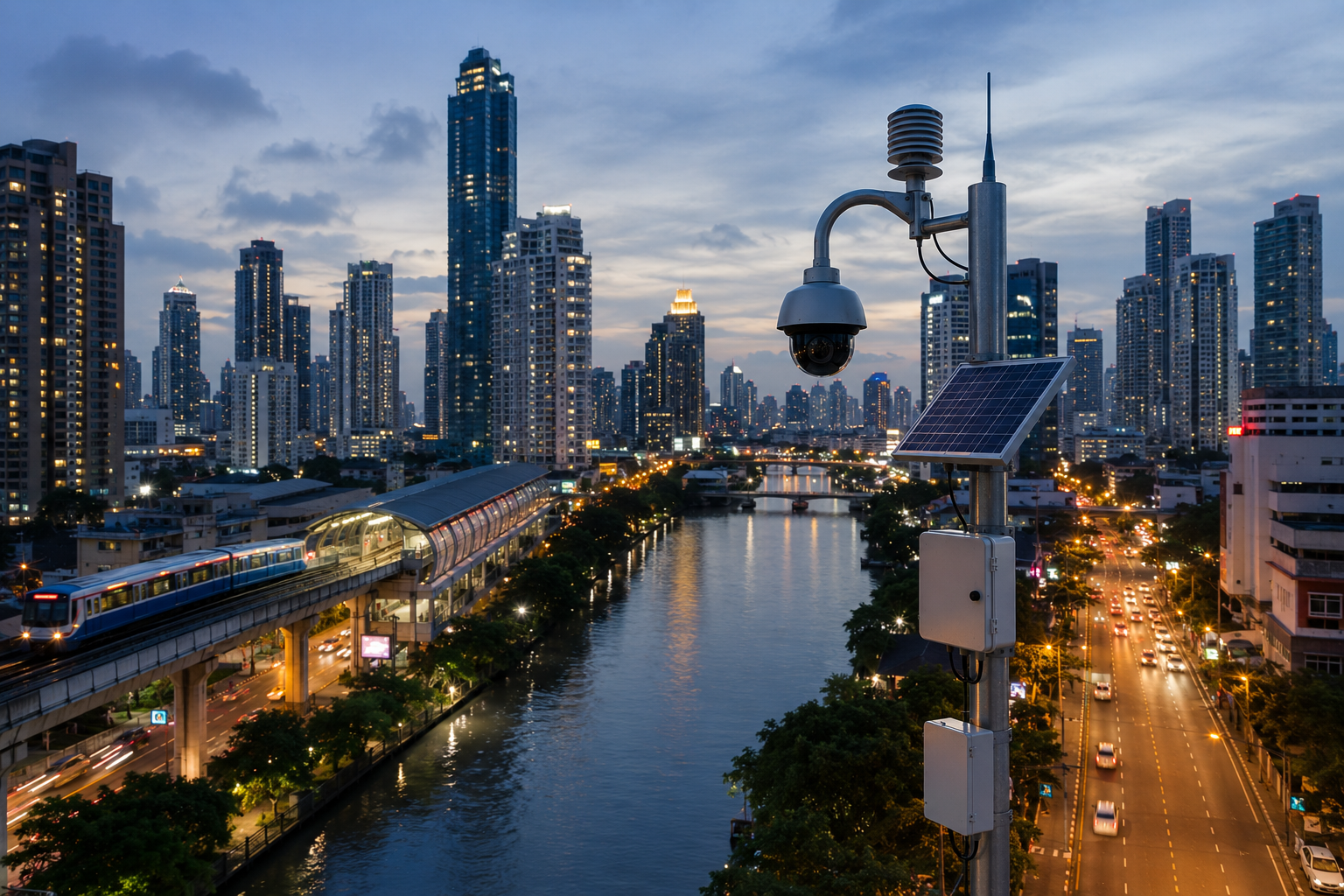
A Smart City is an urban environment that uses technology and data to support city management and public services. By connecting technologies such as AI, IoT, sensors, and monitoring systems, cities can gain better visibility into changing conditions, analyze information, and respond to events more efficiently.
But becoming a Smart City does not mean filling every corner of a city with advanced technology.
A more important question is:
“How can we use data and technology to solve real urban problems?”
From flooding and traffic to public safety and environmental monitoring, cities generate enormous amounts of data every day.
When AI + IoT + Data + People work together, that data can become more than information stored in separate systems. It can become a practical tool for understanding situations and improving city management.
A Smart City uses technology and data to support more efficient urban management and improve the ability of city operators to respond to changing conditions.
Think about what happens across a city every day.
CCTV cameras operate across multiple locations.
Water levels need to be monitored in vulnerable areas.
Traffic conditions change throughout the day.
Public and restricted areas require security monitoring.
Different agencies and systems continuously generate operational data.
If each system operates independently, city personnel may need to switch between multiple platforms simply to understand what is happening.
A Smart City is therefore not about installing the largest possible number of sensors or CCTV cameras.
It is about enabling data, technology, and people to work together effectively.
Cities generate large volumes of information around the clock.
The challenge is that people cannot continuously monitor every camera, sensor, and system across an entire city 24/7.
AI can support operators by analyzing information and identifying predefined events or patterns that require attention.
For example, instead of requiring personnel to continuously watch every CCTV feed, AI can help detect events based on defined conditions.
Instead of relying solely on personnel to physically inspect water levels at multiple locations, monitoring systems can transmit field data to a centralized platform.
And rather than evaluating traffic conditions only through manual observation, AI can support Traffic Density Analysis using data available to the system.
The purpose of AI in a Smart City is therefore not to “manage the city instead of people.”
It is to help people see information faster, understand situations more clearly, and make better-informed decisions.
Flooding can affect residents, transportation, public areas, infrastructure, and overall city operations.
A Water Level Monitoring system can help track water-level information from designated monitoring points and transmit that data to a system where responsible personnel can monitor changing conditions.
When this information is used as part of Flood Monitoring, cities can incorporate field data into broader flood surveillance and incident-management processes.
One of the most important objectives is reducing the gap between:
“Conditions in the field begin to change”
and
“The responsible team becomes aware of the situation.”
The faster relevant information reaches city operators, the more time they have to assess the situation and carry out appropriate response procedures.
Traffic is one of the most dynamic systems in any city.
Traffic volume in the morning may be very different from conditions later in the day, while an incident at one location can affect surrounding areas.
AI can be applied to Traffic Density Analysis to help analyze traffic conditions using information available to the system.
When city operators gain a more structured view of traffic data, that information can support situational monitoring and urban management.
This represents an important shift from simply:
“Having cameras”
to:
“Having useful information.”
And that is one of the fundamental principles behind a Smart City.
Cities contain many different areas that require monitoring from public spaces and buildings to roads and restricted zones.
Relying entirely on personnel to monitor large numbers of CCTV feeds can be challenging, particularly when systems need to operate continuously.
AI can work with cameras and other connected systems to help identify events based on predefined conditions.
Relevant capabilities can include:
Intruder Detection helping detect unauthorized access to designated areas.
Suspicious Object Detection helping identify suspicious objects according to defined conditions.
License Plate Recognition recognizing license plate information based on the system's configuration.
Path Track Technology supporting path tracking according to system capabilities.
Staff Counting supporting the counting of people within designated areas.
AI therefore acts as another tool that helps operators focus on events requiring attention rather than depending solely on people to continuously monitor every data source.
A Smart City should not only be capable of collecting data.
It should also make relevant information accessible to the people who need it at the right time.
Information about an incident can become less useful for immediate response if it reaches responsible teams too late.
Canal One's ASAP supports an On-the-Go Monitoring System, allowing users to monitor events across devices such as smartphones, tablets, and monitors.
The platform also supports Real-Time Notifications through appropriate devices and communication channels based on the system design.
The principle is simple:
Right Information → Right Person → Right Time
Relevant information should reach responsible personnel quickly enough for them to assess the situation and determine the appropriate next action.
One of the major challenges in Smart City development is not necessarily a lack of data.
Often, the data already exists but it is distributed across separate systems.
CCTV may operate on one platform.
Water-level data may be stored in another.
Traffic information may appear on a different dashboard.
Notifications may come through another system.
When systems operate as separate data silos, it becomes more difficult to use information together effectively.
This is where Smart Integration becomes important.
The objective is not to force every city system to use the same type of device. Instead, relevant systems and information should be designed to work together where appropriate.
When data can be connected, city operators can gain a broader and more useful view of what is happening across the urban environment.
Smart City transformation can raise an important question:
“Do we need to replace all existing infrastructure before we can begin?”
Not necessarily.
Canal One's approach starts by analyzing the user's problems and requirements before designing and customizing systems that can work with existing infrastructure and data where appropriate.
This allows Smart City development to become a gradual transformation rather than a project that always requires rebuilding everything from the beginning.
A city can start with its most important pain points, such as:
Flooding
Traffic
Security
Environmental Monitoring
It can then connect information and expand capabilities according to actual operational needs.
Detecting an event is only the first step.
The more important question is:
“Once the city knows what is happening, what happens next?”
Smart City systems should therefore consider not only monitoring but also Incident Response.
A typical flow can be represented as:
AI / Sensor Alert → Incident Detail → Human Interaction → Response
AI or sensors detect an event.
The system provides incident details.
Operators assess the situation.
The appropriate response follows based on the defined process.
Where automation is supported and appropriate for the use case, certain responses may also be connected to other devices.
This is where a Smart City moves beyond simply “having data”
toward being able to “use data to support response.”
For Canal One, the Smart City concept is closely connected with ASAP All Smart AI Platform.
ASAP is a management platform that enables AI to work alongside existing operational equipment, enhancing the ability to analyze, differentiate, detect trends in abnormal situations, and provide alerts.
Its capabilities cover three core areas:
Safety Security Environment
These areas can support different dimensions of city management.
For Safety, relevant applications include Smoke and Fire AI Detection.
For Security, capabilities include Intruder Detection, License Plate Recognition, Suspicious Object Detection, and Path Track Technology.
For Environment, capabilities include Water Level Monitoring, Air Quality Monitoring, Temperature Monitoring, and Energy Management.
When information from different areas can be managed more systematically, city operators gain greater visibility across multiple aspects of the urban environment.
One of Canal One's Smart City use cases is Rangsit City Municipality.
Canal One's approach began with analyzing user problems and requirements, followed by designing and customizing the system to work with existing infrastructure and data.
Through the Rangsit Smart City Application, technologies have been applied to:
AI Water Level Monitoring
Monitoring water levels.
Flood Monitoring
Monitoring flood conditions.
Traffic Density Analysis
Analyzing traffic density.
Intruder Detection
Detecting unauthorized access.
These applications are identified in Canal One's Smart City use case for Rangsit City Municipality.
The example illustrates why Smart City development does not necessarily need to begin with the question:
“What technology should a city have?”
A more useful starting point is:
“What problems is the city trying to solve, and where can data and technology help?”
Smart Cities are not only about traffic and security.
The environment is another important part of urban management and quality of life.
IoT and monitoring technologies can be applied to environmental information such as:
Water Level Monitoring
Air Quality Monitoring
Temperature Monitoring
Energy Management
By continuously monitoring relevant information, city operators can gain greater visibility into environmental conditions based on field data.
This connects directly with one of Canal One's key impact areas:
Environments Responsive
Canal One positions Smart Cities, IoT sensing, and climate resilience within this impact area, alongside its broader goals of making People Safer and Businesses Smarter.
A city can deploy advanced AI, install thousands of sensors, and build large monitoring dashboards.
But if the systems are difficult for operators to use—or if the information does not help address real problems—the technology may fail to deliver its full value.
A Smart City should therefore be built around Human-First Technology.
Technology should help reduce operational complexity.
It should make important information easier to access.
It should support faster responses to changing situations.
And ultimately, it should create meaningful value for the people who live and work in the city.
This is why Human-Centric Design and User Experience are as important as AI and IoT.
Because cities are not built for technology.
Technology should be built for the people who use the city.
Urban management needs traffic, flood and safety information brought together before coordinating the relevant agencies. For an Integrated Operation Center (IOC) supporting this work, a comprehensive safety and security incident management platform should maintain information continuity from notification through coordination with the responsible team.
A Smart City should not be measured simply by the number of sensors, CCTV cameras, or AI systems it has deployed.
A more important measure is:
Can the city turn that information into better decisions and more effective responses?
AI helps analyze information.
IoT and sensors help collect data.
Smart Integration helps connect systems.
Real-Time Monitoring helps deliver information to relevant people.
And people remain at the center of critical decision-making.
When these elements work together, a city does not simply become “smarter.”
It can become safer, more aware of changing conditions, and more responsive to the needs of its people.
This reflects Canal One's vision of creating intelligent systems that help make:
People Safer Businesses Smarter Environments More Responsive
Canal One AI and IoT Orchestration for Safety, Intelligence, and Seamless Innovation.




We’re ready to help your team take the next step in safety, sustainability, and smart operations.