





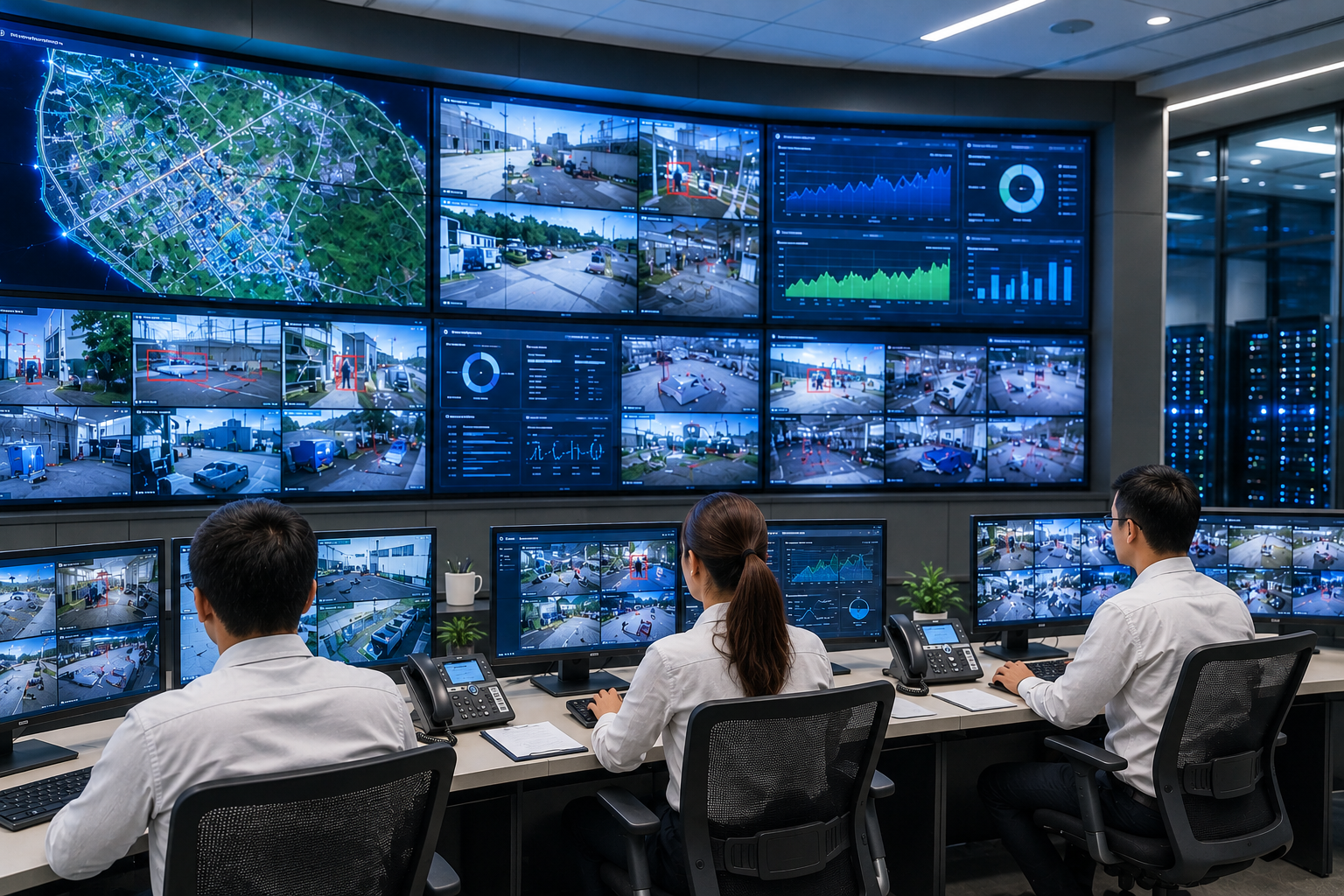
When an organization operates hundreds of CCTV cameras, sensors distributed across multiple locations, a separate Access Control system, radio communication systems, and multiple Dashboards and Software platforms from different vendors, the problem may no longer be a lack of data.
Instead, the challenge is that there is a large amount of data, but it is not presented as one connected operational picture.
When an incident occurs, personnel may need to switch between multiple screens, review information from different systems, and coordinate with several teams by phone or radio before they can understand what is happening and determine how to respond.
This is why the concept of an Integrated Operations Center, or IOC, is becoming increasingly important for organizations that need to manage Security, Safety, and Operations across multiple systems at the same time.
In simple terms, an Integrated Operations Center (IOC) is an operational center that connects information from different systems and devices to create a unified view of a situation, helping teams monitor, analyze, receive alerts, coordinate, and make decisions based on more connected information.
For Canal One, this concept aligns with connecting People, Data, and Intelligent Devices through Seamless and Human-Centric technology. It also includes the use of ASAP, or All Smart AI Platform, as part of an AI-driven approach to analyzing, classifying, detecting abnormal situations, and generating alerts from relevant data and connected devices.
An IOC, therefore, should not be viewed simply as “a room with large screens.”
What matters more is how effectively the systems behind those screens connect data and Workflows together.
When people think of an IOC, the first image that often comes to mind is a large Control Room with a Video Wall and operators monitoring multiple screens.
However, having many screens does not automatically make a room an Integrated Operations Center.
A traditional Control Room may have a CCTV system for video monitoring, an Alarm system for alerts, Sensor systems for monitoring different conditions, and radios for communicating with personnel. Each system may perform its own function effectively, but the information can still remain separated in Silos.
When an Alarm occurs, operators therefore have to connect the information themselves.
They need to identify where the Alarm originated, open the CCTV feed for that location, check the relevant Sensor data, contact field personnel, and then follow up to determine whether the incident has been resolved.
An IOC aims to shift the approach from having “multiple systems in the same room” to enabling “multiple systems to work together.”
That is the essence of the word Integrated.
The real value does not come from the number of screens. It comes from the ability to bring relevant information together so operators can understand the situation more clearly and proceed through a more systematic operational process.
Imagine a large factory at night.
CCTV cameras along the perimeter detect an abnormal event. At the same time, other systems may be receiving information from Sensors or devices installed in the same area. If these systems operate separately, personnel may need to search through each source individually before they can assess the situation.
When the environment is designed around Integrated Operations, however, relevant information can be brought into a more connected Workflow.
AI Video Analytics may help detect an event from CCTV footage. The system can generate an Alert and send a Notification to the appropriate personnel through relevant channels, while information from other devices can provide additional Context around the incident.
Within Canal One's approach, ASAP supports AI-Based Safety & Security Detection for applications such as Intruder Detection, Smoke and Fire AI Detection, PPE Safety, Suspicious Object Detection, Face Recognition, and License Plate Recognition. It also supports Real-Time Notification through channels including applications, APIs, direct messages, strobe lights or sirens, and portable radios.
An IOC, therefore, is not simply about putting all available data “on display” on a single Dashboard.
It is about making that information relevant to the incident and to the way personnel actually work.
Instead of requiring people to search across multiple systems, a more integrated environment should help bring incident-related information into the same operational context to support verification and decision-making.
If an IOC simply gathers and displays large amounts of information, it can create a new problem.
Instead of having ten Dashboards spread across different systems, an organization may end up with one Dashboard overloaded with so much information that operators do not know what deserves attention first.
This is where AI can play an important role.
AI is not valuable simply because it generates more data. It can help analyze, classify, and detect events that match predefined conditions, enabling personnel to focus more effectively on relevant situations.
CCTV provides a clear example.
In a traditional IOC, operators may need to monitor feeds from many cameras. When AI Video Analytics is added, the system can help detect predefined Use Cases such as intruders, smoke or fire, missing PPE, or suspicious objects, and then feed detected events into an Alert Workflow.
The role of AI in an IOC, therefore, should not simply be to add the word “Smart” to a Control Room.
It should help transform large volumes of data into information that has meaning within the context of an operational situation.
From Data Visibility to Situational Awareness.
And from seeing “what information is available” to understanding “what requires attention right now.”
Real-world incidents rarely involve only one type of information.
If an abnormal event occurs in a factory, CCTV may provide visual information, while IoT Sensors provide environmental data. Communication systems deliver information to personnel, while other devices may support verification or response.
When these systems remain separate, personnel unintentionally become the Integration Layer.
Someone has to open one system to view the footage, another to check the data, and then use a phone or radio to pass the information to another team.
This is why Smart Integration is at the heart of the IOC concept.
Canal One positions ASAP to work with multiple components, including CCTV, Smart Drones, Smart Robots, Integrated Communication Systems, Smart Voice Radio, and Advanced Thermal Sensors, with the goal of connecting People, Data, and Intelligent Devices.
Organizations should therefore look beyond how many systems an IOC can “display.”
The more important question is how effectively those systems can exchange information and support a continuous Workflow.
Displaying CCTV, Sensor data, and Alarms on the same screen does not necessarily mean the systems are truly integrated if personnel still have to manually copy information, make calls, and operate every system separately when a real incident occurs.
In large organizations, Security Infrastructure often grows over time.
CCTV may be installed as part of one project. Access Control may come from another. Sensors may be added later, while the communication system may already exist as part of the organization's Infrastructure.
Over time, the organization may no longer have “one security system.” Instead, it may have many independent subsystems, each performing its own function.
The concept of a Unified Security System aims to reduce this fragmentation by creating stronger connections between data and Workflows across different components.
An IOC can therefore act as an Operational Layer that brings Unified Security into real-world operations.
Personnel should not need to know which Software platform every piece of information came from before they can respond to an incident. Instead, they should be able to understand the situation, see relevant information, and access necessary Actions through a Workflow designed around actual operational needs.
This is one reason Canal One emphasizes Human-Centric Design.
Good Integration is not only about enabling Machine-to-Machine communication. It should also make information from connected systems easier for people to use.
One of the most important measures of a Security & Safety system is not simply whether an incident can be detected.
It is how long it takes for the response to begin after detection.
This period can be described as the Response Gap.
In disconnected systems, an Alarm may be generated immediately, but personnel still need time to open information, check cameras, contact relevant teams, and gather Context before making a decision.
An IOC designed to connect data and Workflows can help reduce some of these steps.
ASAP supports Real-Time Notification through multiple channels. When combined with AI Detection, incident information can be routed to the appropriate personnel according to the Workflow designed by the organization.
When Automation is introduced, the concept can go even further.
Canal One's ASAP+ extends these capabilities with Automation, including automated device control and the ability to deploy a Drone to an incident location.
As a result, the flow of a modern IOC can evolve from:
Data → Monitor → Human
toward a more connected process such as:
Data → AI Analysis → Detection → Alert → Communication → Action → Human Decision → Response
The goal is not to remove humans from the system. It is to help ensure that the information and Actions they need reach them faster.
The larger the site and the more complex its systems, the greater the value of centralized situational visibility.
A factory may include Production, Warehouse, Utility, Perimeter, and Restricted Areas within the same site, but each area can have different risks.
One area may prioritize Intruder Detection. Another may need PPE Compliance monitoring, while another may focus on Smoke and Fire Detection.
If every Use Case operates through an entirely separate system, operations teams must manage large amounts of information simultaneously.
An IOC can help create a Common Operational Picture, allowing information from different locations and systems to be considered together.
For Critical Infrastructure, this becomes even more important because delays between detection, assessment, and response can affect Security, Safety, and Operational Continuity.
The value of an IOC therefore does not come from making a Control Room look more sophisticated.
It comes from enabling fragmented information to support decision-making in a more systematic way.
Many organizations may be interested in building an Integrated Operations Center but are concerned that doing so means replacing all existing CCTV, Sensors, Communication Systems, and Software.
In practice, system design should begin by assessing the organization's Existing Infrastructure.
Canal One emphasizes analyzing user Pain Points and Requirements before designing and customizing a solution around the existing infrastructure.
This approach is especially important for IOC projects because very few large organizations start from a completely blank environment.
The question should therefore not simply be:
“What new systems do we need to buy?”
A more useful question is:
“How much of the data and equipment we already have can be connected?”
Some systems may support direct Integration. Others may require additional customization, while certain devices may have limitations that need to be assessed individually.
A well-designed IOC is therefore not about forcing every organization to use the same Architecture. It is about designing Integration around the organization's actual Environment and Workflow.
Extending an Integrated Operation Center (IOC) with data analysis and connected workflows supports the concept of a Smart Integrated Operation Center, or Smart IOC: an intelligent, integrated situation-management center that helps teams work from shared information.
Here, an intelligent operations system supports notification, verification, coordination and response follow-up. A comprehensive safety and security incident management platform connects that information with the operators' workflow.
The future of the Control Room may not be measured by the number of screens or the size of the Video Wall.
It may instead be measured by its ability to transform large volumes of information into Situational Awareness and Actionable Information.
When CCTV works with AI Video Analytics, when Sensors and IoT devices feed information into connected systems, when Alerts reach the appropriate people through relevant Communication Channels, and when Automation supports predefined Workflows, the operations center begins to evolve from a place for “monitoring” into a center for “understanding and managing situations.”
This direction aligns with Canal One's concept of AI & IoT Orchestration.
It is not about placing every technology in the same room. It is about enabling People, Data, and Intelligent Devices to work together Seamlessly.
So, if the question is:
“What is an Integrated Operations Center (IOC)?”
The most important answer may not be:
“An IOC is a large Control Room.”
Instead, an IOC is a centralized operational environment that connects data, systems, devices, and Workflows to help an organization gain situational visibility, analyze incidents, communicate, and respond in a more systematic way.
As organizations continue to generate more and more data, the advantage does not necessarily belong to “whoever has the most data.”
It belongs to those who can answer a more important question:
“When an incident occurs, who can turn the available data into understanding and response faster?”




We’re ready to help your team take the next step in safety, sustainability, and smart operations.