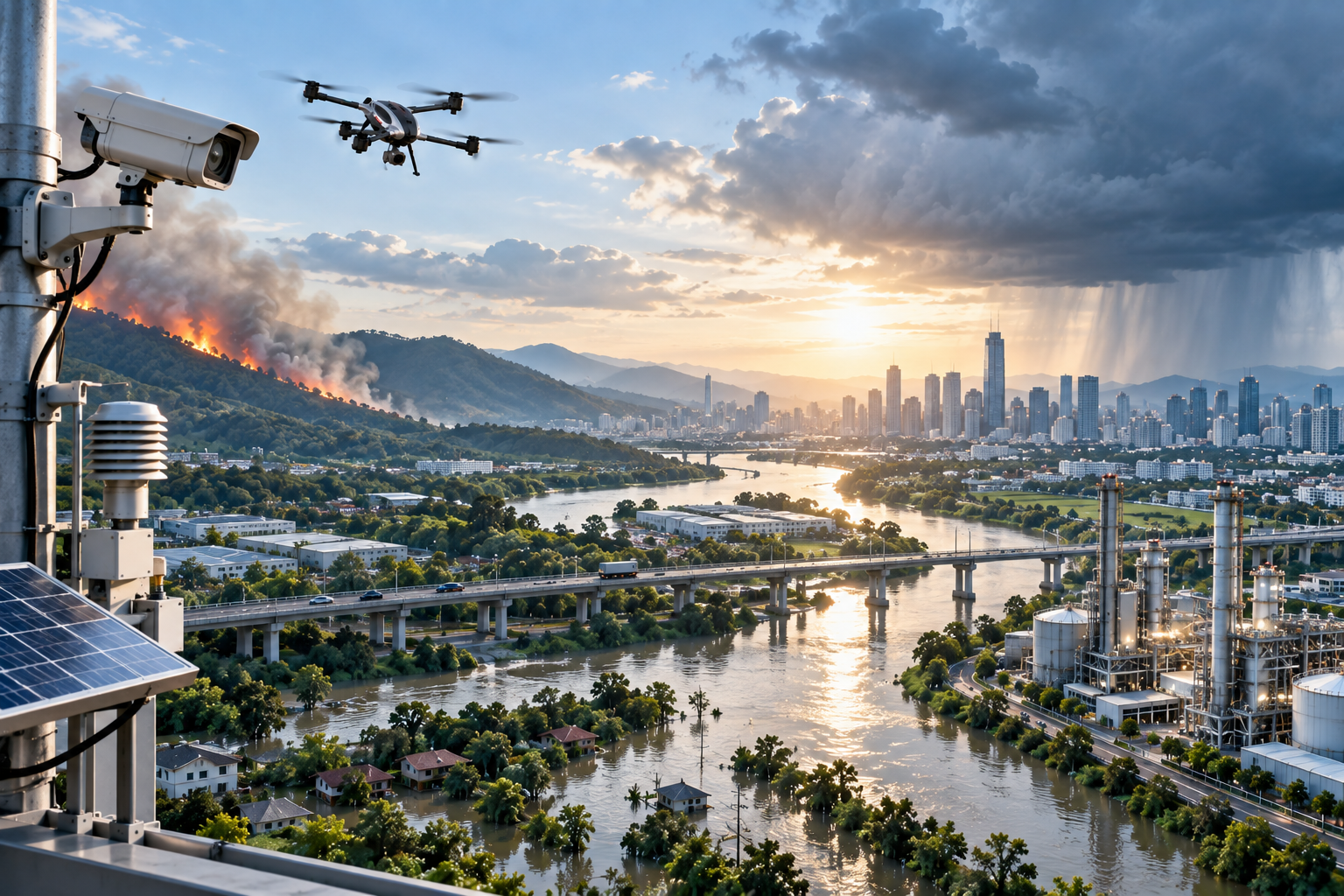
The World Bank’s Disaster Risk Management – Overview clearly emphasizes that disaster risk management is not solely the responsibility of emergency response agencies. It is a national development strategy that must be properly designed today.
The objective is to enable countries to:
- Assess risks
- Reduce impacts
- Manage disasters systematically
This approach must comprehensively cover:
- Preparedness
- Resilient infrastructure
- Effective early warning systems
This article summarizes key concepts from the World Bank’s perspective and connects them with the approach of Canal One and the ASAP (All Smart AI Platform)—demonstrating how Thai organizations can apply these principles to factories, cities, and critical infrastructure.
Disaster Risk Management (DRM) – The World Bank Perspective
According to the World Bank framework, Disaster Risk Management (DRM) means ensuring that countries, cities, and organizations:
1. Know the Risk
- Floods
- Landslides
- Earthquakes
- Wildfires
- Industrial fires
- Chemical leaks
- Environmental risks such as PM2.5 pollution and extreme heat
2. Reduce the Risk
- Invest in resilient infrastructure
- Develop zoning regulations and safety standards
- Strengthen structural and environmental protection measures
3. Prepare and Respond
- Implement functional Early Warning Systems
- Establish command centers and cross-agency coordination
- Ensure rapid emergency response capability
4. Recover and Build Back Better
- Restore economic activity and communities
- Improve regulations and systems to prevent repeated failures
In simple terms:
DRM = Investing today to reduce losses and ensure long-term sustainability.
Why the World Bank Emphasizes Resilient Infrastructure and Early Warning
The World Bank stresses that sustainable development cannot rely on repairing damage after disasters occur. Instead, countries must focus on:
1. Resilient Infrastructure
Infrastructure should be designed to withstand hazards beyond traditional standards, including:
- Roads, bridges, dams, power grids, and water systems
- Hospitals, schools, factories, warehouses
Examples include:
- Drainage systems capable of handling extreme rainfall
- Buildings engineered for wind and seismic resilience
- Factories equipped with automated fire, smoke, and chemical detection
2. Early Warning Systems
Critical questions include:
- When will flood levels exceed barriers?
- When will PM2.5 spike to hazardous levels?
- What is the real-time flood situation in industrial zones?
- Is there fire or intrusion in sensitive areas?
The earlier risks are identified, the faster people and assets can be relocated and response measures activated.
From the World Bank Framework to Practical Application in Thailand
Thailand frequently faces:
- Flash floods in cities and industrial estates
- Factory and warehouse fires
- PM2.5 pollution in industrial and urban areas
- Emergencies in public buildings, hospitals, and commercial centers
The key question is:
Should organizations rely solely on centralized data from authorities, or should they build their own on-site intelligence systems?
This is where Unified Security, Early Warning, and Automation powered by the ASAP Platform enhance the World Bank DRM framework—making it operational at the site level.
ASAP Platform: Translating DRM Principles into Action
1. Real-Time Risk Awareness (Sense & Assess)
ASAP integrates:
- CCTV systems
- Water-level sensors
- PM2.5, temperature, and gas sensors
- Building Management Systems (BMS/HVAC)
- PA systems, sirens, radios
- Drones and body cameras
Through AI and Edge Processing, the system analyzes:
- Abnormal smoke detection
- Rapidly rising water levels
- Simultaneous air pollution spikes
- Falls, accidents, or intrusions in high-risk zones
This creates real-time risk assessment, aligned with the World Bank’s DRM principles.
2. Early Warning & Smart Notification
When predefined thresholds are met, the system:
- Sends alerts via mobile apps, LINE OA, tablets, radios, sirens, and strobe lights
- Routes notifications based on role (site manager, field staff, executives)
- Minimizes time between detection and decision-making
3. Automation Linked to SOP
Unlike systems that stop at notification, ASAP integrates with automated Standard Operating Procedures (SOP), such as:
- Activating sirens and announcements
- Closing doors or isolating risk zones
- Adjusting HVAC systems to reduce polluted air intake
- Sending community alerts
With ASAP+, drones can be deployed to inspect flood routes, fire zones, or confined areas, feeding real-time data back to the command center.
4. Edge-First Architecture & Green Tech
In alignment with the World Bank’s sustainability principles, Canal One enhances DRM through:
- Edge-first processing to minimize unnecessary cloud transmission
- Reduced bandwidth consumption
- Lower energy usage for surveillance systems
- Green Tech principles to make monitoring systems smarter and more energy-efficient
-
Practical Applications in Thailand
Factories & Industrial Estates
- Detect PPE violations, risky behaviors, smoke, intrusion, and falls
- Monitor warehouses, machine rooms, flood-prone areas
- Build dashboards tracking MTTD, MTTR, and compliance reporting
Smart Cities & Municipalities
- Multi-point monitoring of water levels and PM2.5
- Risk heatmaps
- Early warning triggers for road closures and traffic redirection
- Integration with public transportation systems
Critical Infrastructure
- Smart Integrated Operation Centers (IOC)
- Integration of power plants, substations, transport systems
- Real-time risk management to prevent service disruption
Applying disaster management lessons in an organization should begin with risk locations and information handovers between teams. A comprehensive safety and security incident management platform working with an Integrated Operation Center (IOC) should connect essential information with the team's verification and response steps.
Conclusion: From World Bank Framework to Organizational Action
The World Bank makes it clear:
Investing in Disaster Risk Management ensures:
- Economic continuity despite disasters
- Safer cities and communities
- Truly sustainable development
At Canal One, we believe the next phase of DRM must integrate:
- AI Security
- Unified Security Systems
- Early Warning
- Green Technology
All unified under a single platform: ASAP
So Thailand can:
- See earlier
- Warn earlier
- Act earlier
On infrastructure that is intelligent, secure, and sustainable.