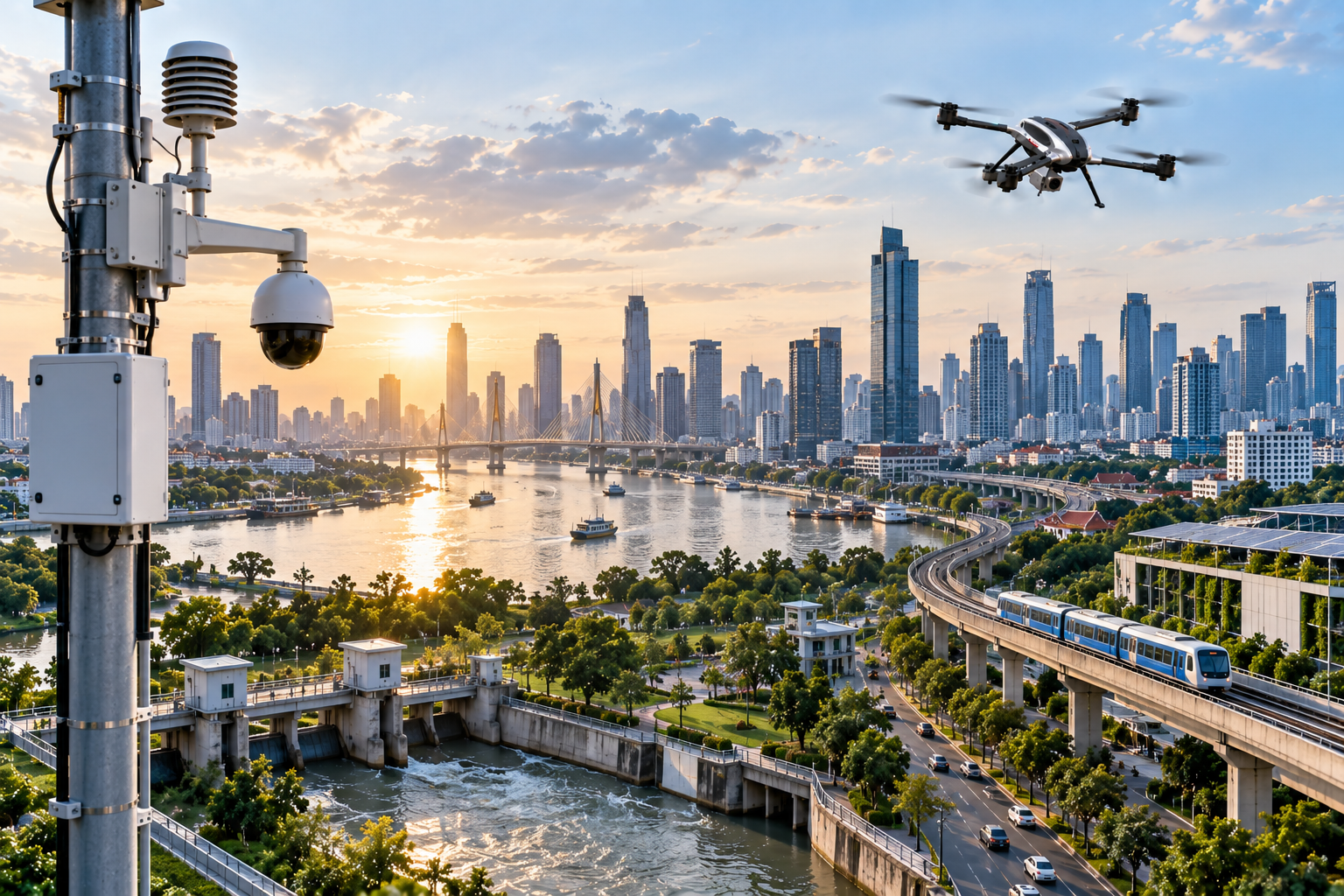
The World Bank’s document Building Urban Resilience: Principles, Tools, and Practice is designed as a practical guide for urban planners, local government leaders, and infrastructure agencies.
Its objective is to help cities build urban resilience through:
- Reliable risk data
- Integrated Disaster Risk Management (Integrated DRM) tools
- Early warning and response systems that function effectively on the ground
These principles strongly align with Canal One’s approach in developing Intelligent Incident Management and Unified Security Systems, powered by AI on the ASAP Platform.
What Is Urban Resilience and Why It Matters for Thailand
Urban resilience is the capacity of a city to withstand, recover, and continue growing, even when facing disasters, emergencies, or socio-economic disruptions.
For Thai cities, familiar risks include:
- Flash floods in low-lying urban areas
- Fires in dense communities, shopping malls, markets, and warehouses
- PM2.5 air pollution from traffic and industry
- Crowd density risks at events, transport hubs, and tourist locations
A “resilient” city is not one that never experiences incidents.
It is a city that:
- Detects risks early
- Issues warnings early
- Responds quickly enough to minimize impacts on lives, the economy, and infrastructure
-
Core Principles from the World Bank: Building Urban Resilience
The World Bank identifies three main pillars that Thai organizations and municipalities can immediately apply:
1. Systematic Risk Awareness
- Develop risk maps and hazard maps
- Integrate data on floods, landslides, earthquakes, fires, and pollution
- Connect data on critical infrastructure such as power plants, pumping stations, and hospitals
The goal:
Cities must know which zones face what risks—and how severe those risks are.
2. Integrating Urban Planning with DRM
- Align zoning with risk exposure (avoid rebuilding in repeatedly high-risk areas)
- Invest in resilient infrastructure
- Develop Integrated Disaster Risk Management that connects all agencies
3. Using the Right Data and Tools in Practice
The World Bank highlights that cities should have at minimum:
- Real-time monitoring of water levels, rainfall, and air quality
- Early warning systems capable of alerting citizens and agencies instantly
- A Command & Control or Operations Center with city-wide visibility
- Multi-channel communication (public address systems, digital signage, smart city apps, etc.)
From Principles to Practice: Cities Need a “Central Intelligence Layer”
One key message from the World Bank is that cities can no longer operate in silos.
In many municipalities:
- CCTV data sits with security departments
- Water and rainfall data is managed by separate agencies
- Air quality and health data belong to another division
- Citizen complaints and emergency calls exist in separate platforms
To truly build urban resilience, cities require a central platform that:
- Connects all data and devices
- Uses AI to analyze, filter, and prioritize incidents
- Automates alerts and response actions based on clear SOPs
This is where the ASAP (All Smart AI Platform) from Canal One plays a crucial role.
ASAP Platform: Turning Urban Resilience into Action
1. Unified Security & Environmental Intelligence
ASAP integrates:
- City CCTV systems, transport hubs, public buildings
- Flood and rainfall sensors
- Air quality (PM2.5) and temperature monitoring
- Public address systems, digital signage, radios
- Field units using drones and bodycams
- Building systems (BMS/HVAC) in malls, hospitals, and stadiums
All unified into a single operational view for city executives and command centers.
2. Early Warning + Smart Notification
When risk thresholds are reached—such as:
- Rapidly rising water levels
- PM2.5 exceeding safe limits
- Fire smoke or intrusion detection
- Crowd density surpassing defined thresholds
ASAP can:
- Send alerts via mobile apps, LINE OA, radios, sirens, and digital signage
- Route notifications by role (field officers, engineers, city directors, mayors)
- Reduce the time from “incident occurrence” to “decision-making and response”
3. SOP Automation: Acting Before Manual Intervention
Cities can configure automated responses, such as:
- When water reaches Level X → close roads or tunnel entrances → notify drivers
- When PM2.5 exceeds threshold → adjust HVAC systems → alert schools and parents
- When smoke is detected → trigger alarms → notify fire departments → display incident footage in the command center
With ASAP+, drones can be automatically deployed to inspect riverbanks, flood-prone zones, or high-rise rooftops during incidents.
4. Edge-First + Green Tech for Modern Cities
To balance speed and sustainability:
- Edge-first AI processes data locally, reducing reliance on cloud transmission
- Minimizes bandwidth consumption and improves resilience during connectivity disruptions
- Green Tech architecture reduces energy usage of city-wide camera and network systems
- Lowers overall carbon footprint
A 30–60–90 Day Roadmap for Thai Cities
First 30 Days: Assess Assets & Risks
- Inventory existing cameras, sensors, PA systems, radios, apps
- Identify high-risk zones (flood-prone areas, industrial zones, dense communities)
60 Days: Integrate & Configure Early Warning
- Connect existing devices into the ASAP Platform via Smart Integration / APIs
- Establish alert thresholds (water levels, PM2.5, crowd density, fire detection)
- Implement real notification channels used daily by teams
90 Days: Automation & Smart IOC
- Link incidents to automated SOP actions
- Expand into a Smart Integrated Operation Center (IOC) for city-wide visibility
Turning resilient city plans into practice requires identifying information to monitor and agencies that need to coordinate. This is a practical context for an Integrated Operation Center: an intelligent, integrated situation-management center designed to connect information and coordinate the people responsible.
Conclusion: From World Bank Framework to Real Resilience in Thailand
The World Bank’s Building Urban Resilience: Principles, Tools, and Practice clearly emphasizes that modern cities must invest in:
- Accurate risk intelligence
- Early warning and Integrated DRM tools
- Resilient infrastructure and incident management systems
At Canal One, we extend this framework with:
- ASAP Platform – Unified Security System
- AI Security & Safety
- Smart Integration
- Green Technology
So Thai cities can:
- Detect earlier
- Warn earlier
- Act earlier
And build urban resilience that is:
- Measurable
- Practical
- Sustainable—both in safety and environmental impact