





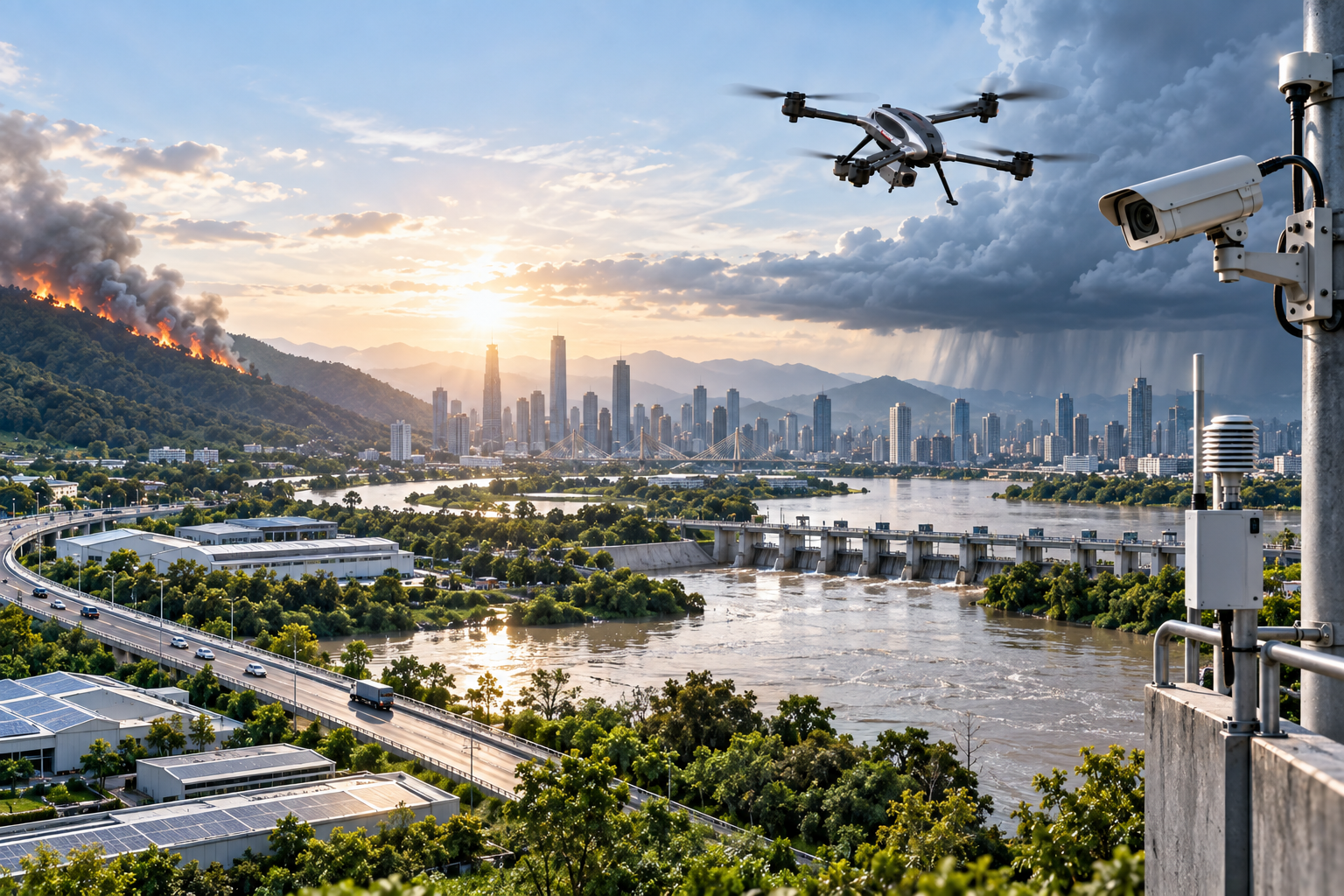
A policy report from global development institutions such as the World Bank clearly highlights that:
“Investing in Disaster Risk Management (DRM) is not a luxury cost,
but a fundamental foundation of sustainable economic and social development.”
Today the world is facing wildfires, floods, severe storms, factory fires, failures of critical infrastructure,
and emergencies in major cities. The key question for countries, cities, and the private sector is:
Will we “wait for disasters to happen and then repair the damage”
or “invest in managing risk in advance so that losses are minimized”?
This article takes you Back to Basics and explains clearly
why investment in Disaster Risk Management (DRM) is crucial for global development,
and how Canal One views the role of AI technology and the ASAP Platform in this bigger picture.
Disaster Risk Management (DRM) is not just about
“rescuing people after a flood or fire.”
It is a full risk-management cycle that runs from upstream to downstream:
Understanding clearly where and what the risks are:
Designing measures in both physical and systemic dimensions:
The core of DRM is the shift from
“waiting for disasters and then responding” → to → “seeing risks early and reducing damage as much as possible”.
A single major disaster can cause:
Investment in DRM—for example:
helps us reduce downtime, lower damage costs, and maintain business continuity.
From an economic standpoint, this is an investment that is far more cost-effective than rebuilding every time after a disaster.
Any model of development that comes at the cost of large-scale loss of life
cannot be called “sustainable development”.
Examples include:
All of these help workers and communities feel safer.
That sense of safety translates into:
DRM is directly linked to several Sustainable Development Goals, such as:
As the world faces more global warming and climate volatility,
we urgently need systems that can predict, provide early warning, and actually reduce the impact of natural hazards.
Resilience does not mean “never falling”.
It means “when we fall, we can get back up quickly, with minimal loss.”
Good DRM helps:
This is system-level resilience, and it is something countries around the world are seriously investing in.
We are moving from an era that relied almost solely on
“human eyes and human experience”
to one that leverages AI + IoT + Edge Computing so we can:
“See earlier, think faster, and act automatically.”
Key technologies include:
Detecting smoke and fire, intrusions, falls, missing PPE, crowd density, and more.
Measuring water levels, air quality (PM2.5), temperature, gases, and chemicals.
Processing data on-site in real time, reducing dependence on the cloud—
ideal for locations with unstable connectivity.
Integrating data from cameras, sensors, building systems, radios, and IT systems
into a single screen.
All of these principles are what Canal One builds into ASAP (All Smart AI Platform).
ASAP connects:
into one platform, so:
all see the same situation and can make decisions together quickly.
ASAP doesn’t just pop up an alert on a screen. It can:
And when upgraded to ASAP+, it can:
ASAP is designed with an Edge-first + Green Tech approach:
Disaster risk investment should connect warning systems with command coordination and usable response plans. For an Integrated Operation Center (IOC) supporting this work, a comprehensive safety and security incident management platform should maintain information continuity from notification through coordination with the responsible team.
Revisiting the original question:
Between “waiting for disasters and then fixing the damage”
and “investing ahead of time to reduce loss”,
which is truly more valuable—for the world and for your business?
Investing in Disaster Risk Management is investing in:
This is why Canal One has developed the ASAP Platform to be more than just a
“CCTV + AI system”.
It is a Smart Safety & Resilience Infrastructure that helps Thailand—and the world—
see earlier, warn earlier, and act earlier,
with transparency, strong standards, and environmental responsibility.
If you are looking for solutions in Disaster Risk Management, Unified Security Systems, and Green Tech
for your factory, city, or critical infrastructure,
the Canal One team is ready to help design a 30–60–90 day roadmap—
starting from small high-risk zones and scaling into a full intelligent system
that is both measurable and truly worth the investment.




We’re ready to help your team take the next step in safety, sustainability, and smart operations.