





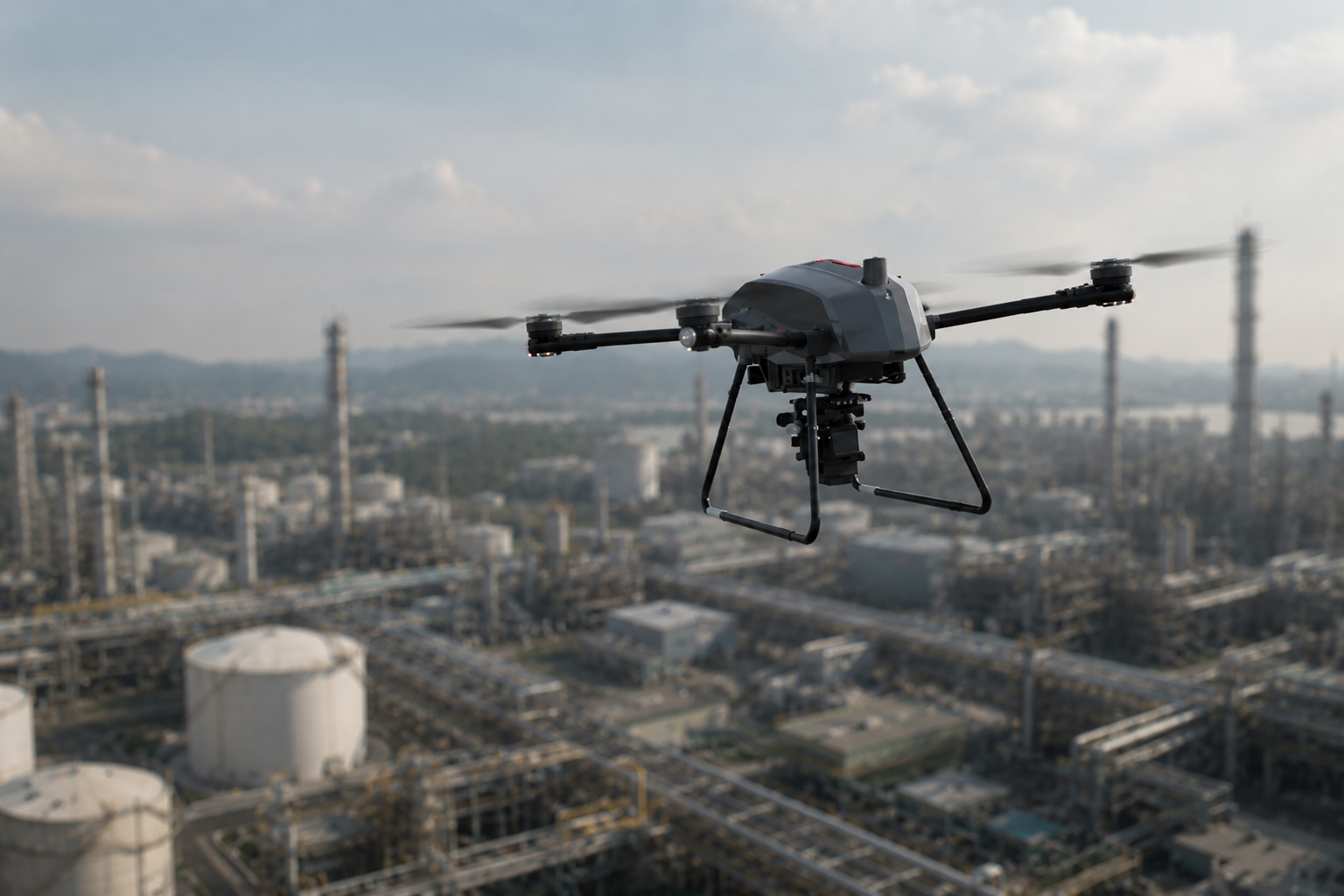
As organizations increasingly manage vast facilities, complex infrastructure, and distributed assets, traditional manual inspections are no longer enough.
Whether it’s manufacturing plants, power stations, oil and gas pipelines, airports, logistics hubs, or Smart City projects, organizations require accurate, timely, and actionable data to make informed decisions.
This is why Automated Drone Inspection is gaining momentum among leading organizations worldwide. By transforming conventional inspection processes into intelligent, safer, and more efficient operations, drone technology is redefining how critical assets are monitored and maintained.
Automated Drone Inspection is the use of drones equipped with cameras, sensors, and intelligent technologies to inspect facilities, infrastructure, and large areas through pre-programmed autonomous flight missions.
Instead of sending personnel into hazardous or difficult-to-access environments, drones can perform inspections with precision while collecting real-time visual and sensor data.
When integrated with AI-powered analytics and intelligent management platforms, the collected information becomes more than just images and videos. It becomes actionable intelligence that enables organizations to assess risks, monitor operations, and make faster, data-driven decisions.
Traditional inspection methods are often time-consuming, costly, and potentially dangerous for personnel, especially when dealing with hazardous environments or large-scale assets.
Automated Drone Inspection addresses these challenges effectively.
Drones can safely access high-risk locations such as:
This minimizes the need for personnel to enter dangerous areas and significantly reduces workplace risks.
Inspecting hundreds or thousands of acres manually can take days or even weeks.
Drones can cover the same areas within hours while capturing highly detailed and consistent data.
Inspection data can be transmitted directly to operations centers, enabling operators and decision-makers to monitor conditions and respond immediately when issues arise.
Early detection of structural issues, equipment failures, or environmental risks helps organizations reduce maintenance costs, prevent costly downtime, and improve asset management strategies.
The process begins with predefined inspection routes and checkpoints, allowing drones to perform repeatable missions with consistent accuracy.
During flight, drones collect data through multiple technologies, including:
The collected data is transmitted to centralized platforms for real-time monitoring, analysis, and reporting.
Drone inspections reduce the need for personnel to work in hazardous locations, lowering the risk of accidents and injuries.
Drones capture detailed and repeatable data, reducing inconsistencies associated with manual inspections.
Potential issues such as structural damage, equipment deterioration, or environmental anomalies can be identified at an earlier stage.
Inspection data can be analyzed over time to identify trends and predict potential failures before they occur.
Executives and operational teams gain access to real-time information through dashboards and mobile applications, enabling faster and more informed decisions.
Drones inspect factory rooftops, pipelines, chemical storage tanks, and hazardous areas without disrupting production operations.
Automated inspections support power transmission lines, substations, solar farms, power plants, and other critical infrastructure assets.
Drones monitor long-distance pipelines, detect leaks, and assess remote operational environments more efficiently than traditional methods.
Cities can leverage drones for flood monitoring, traffic analysis, public safety monitoring, and infrastructure assessments in real time.
Large warehouses and logistics facilities can improve asset visibility and reduce inspection time through automated aerial monitoring.
Many organizations view drones simply as tools for aerial photography or surveillance. However, the true value of Automated Drone Inspection lies in what happens after the data is collected.
Automated Drone Inspection acts as the eyes in the sky, gathering visual and sensor data from large, remote, or high-risk areas in real time.
When this data is integrated into an AI Monitoring system, advanced analytics can automatically detect anomalies, identify risks, and assess operational conditions. This may include identifying abnormal heat signatures, detecting chemical leaks, recognizing unauthorized intrusions, or discovering structural defects before they escalate into major issues.
As a result, organizations gain more than inspection data—they gain actionable insights that support risk management, operational efficiency, and strategic decision-making.
When connected to an intelligent management platform such as ASAP (All Smart AI Platform), organizations can unify data from drones, CCTV systems, IoT sensors, and other security technologies into a single operational view. This enables real-time monitoring, faster incident response, and enhanced situational awareness across the entire organization.
Inspection technology is evolving beyond automated flight toward autonomous decision-making.
Future Smart Drone systems will be capable of:
These capabilities will enable organizations to manage large-scale operations with greater efficiency, accuracy, and resilience.
Canal One develops intelligent solutions that integrate Smart Drones with AI Monitoring, IoT sensors, and Integrated Operations Centers (IOC) under the core principles of Safety, Security, and Environment.
Through the ASAP Platform, organizations can consolidate information from multiple technologies into a centralized command environment, enabling real-time monitoring, risk analysis, and incident response.
This integrated approach reduces human error, improves operational efficiency, and creates a more comprehensive and proactive security ecosystem.
When combined with AI Monitoring and intelligent operational platforms, drone-generated data becomes actionable intelligence that enhances safety, reduces operational costs, and improves overall performance.
For organizations pursuing Smart Operations and Intelligent Infrastructure strategies, Automated Drone Inspection is becoming a critical component of the digital future.
Drone inspection findings should reach asset and site teams so detected anomalies can be assessed. An Integrated Operation Center (IOC) developed as a Smart IOC should connect this information with team verification and coordination, so awareness leads to an appropriate next action.
A drone service for site inspection can apply automated drone inspection workflows by matching smart drone equipment, cameras, sensors and flight routes to the task. When the mission involves security drone monitoring, the collected data should connect with the security team's verification and response process. The value lies in actionable inspection data as well as aerial coverage.




We’re ready to help your team take the next step in safety, sustainability, and smart operations.