





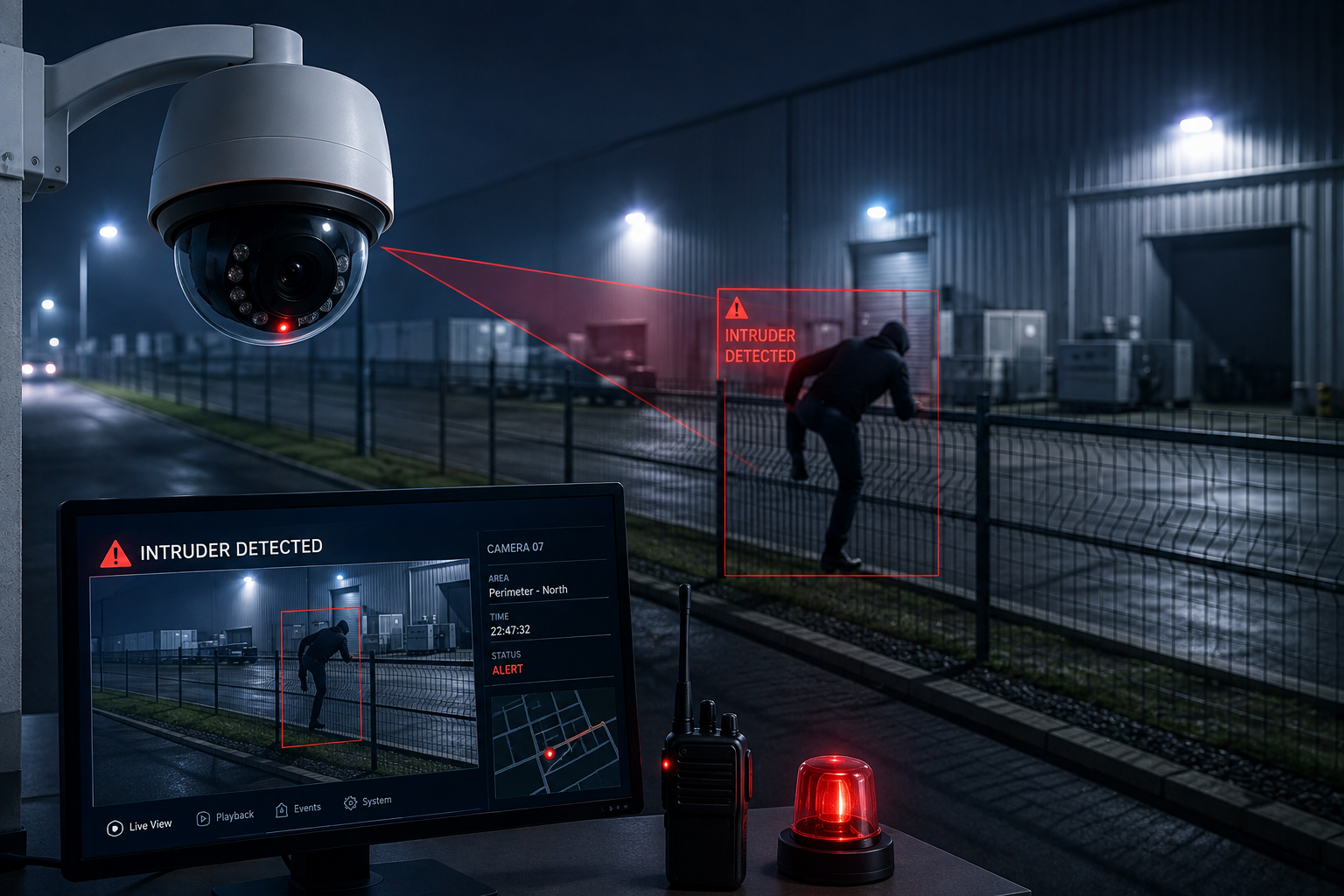
Many organizations already operate extensive CCTV networks. Cameras continuously capture and record activity across factories, warehouses, office buildings, critical infrastructure, and large facilities. But as the number of cameras increases, an important question emerges: Are organizations getting the full value from the cameras they already have?
This is where AI Video Analytics comes in.
AI Video Analytics uses artificial intelligence to analyze video feeds from CCTV cameras and help identify predefined events, objects, behaviors, or abnormal situations automatically. Instead of relying entirely on people to continuously watch multiple screens, AI can help identify events that require attention and turn video footage into actionable information.
For organizations that already have CCTV infrastructure, this creates an important opportunity. Rather than simply installing more cameras, existing video infrastructure can potentially be integrated with AI to improve monitoring, detection, alerts, and operational response.
This approach is central to ASAP, or All Smart AI Platform, by Canal One, which is designed to bring AI into existing operational environments to enhance the ability to analyze, distinguish, detect abnormal situations and trends, and generate alerts.
In simple terms, AI Video Analytics is the use of artificial intelligence to analyze CCTV images or video and identify events, objects, or conditions that the system has been designed to detect.
The key difference lies in what happens after a camera captures an image.
With conventional CCTV, the camera acts as the eyes of the security system. Video is displayed on monitors or recorded for later review, while operators are responsible for interpreting what they see and deciding whether something requires attention.
When AI is added to the process, video feeds can be analyzed to help identify predefined situations. Once a relevant event is detected, that information can then be connected to an alert or another operational workflow.
Canal One applies this approach through ASAP across use cases such as Smoke and Fire AI Detection, PPE Safety, Intruder Detection, Face Recognition, License Plate Recognition, Path Track Technology, Suspicious Object Detection, and Staff Counting.
CCTV can therefore become more than a tool for reviewing evidence after an incident. It can become part of a system that actively supports monitoring while operations are taking place.
Imagine a security control room displaying feeds from dozens of cameras simultaneously.
In theory, operators can see activity across the entire facility. In practice, continuously monitoring large numbers of video feeds requires significant attention, and traditional systems may still depend heavily on personnel to recognize unusual situations.
Canal One identifies this challenge directly: conventional detection, recording, and alert systems may rely primarily on personnel, potentially resulting in errors or delays. Technology can therefore play an important role in improving operational efficiency and reducing Human Error.
AI Video Analytics changes the way organizations manage CCTV information.
Instead of expecting operators to notice everything themselves, AI can help filter events according to predefined conditions and direct attention toward situations that should be investigated.
For Safety and Security operations, this distinction matters because minutes or sometimes seconds—can influence how effectively an incident is handled.
Introducing AI Video Analytics does not necessarily mean an organization must remove its entire CCTV infrastructure and start again.
Canal One's approach is to integrate AI with existing operational equipment where appropriate. The process begins by understanding the organization's challenges, requirements, and existing infrastructure before designing and customizing a suitable solution.
The objective is therefore not simply to “replace every camera with an AI camera.”
A more useful question is: How can video from existing cameras become part of a smarter analysis and management process?
Once video feeds can be incorporated into the appropriate system architecture, AI can analyze them according to the organization's use cases. Detection results can then be connected to dashboards, alerts, or other response workflows.
Canal One's R4 Company Profile also introduces the ASAP AI Box under its Software + AI as a Service offering, using Edge AI technology to process data securely and efficiently. This reflects a broader approach in which AI capabilities can enhance operational infrastructure rather than being viewed only as features built directly into a camera.
Before replacing an entire CCTV network, organizations can therefore begin by evaluating whether their current cameras and infrastructure can work with the required AI solution—and, more importantly, which operational problem they actually want AI to solve.
The value of AI Video Analytics becomes clearer when the system is designed around the specific risks of each environment.
In a factory, one concern may be smoke or fire. In another area, PPE compliance may be more important. Warehouses and restricted facilities may prioritize intruder detection or suspicious objects.
ASAP supports AI-Based Safety Detection across several of these applications. Canal One's USP framework also extends this concept toward AI-Powered Compliance Monitoring, such as monitoring whether employees are wearing required PPE or following defined operational rules.
This gives CCTV footage a role beyond conventional security monitoring.
Video can become a source of operational information that supports Safety and Compliance during everyday operations.
This represents a shift from traditional Video Surveillance toward Video Intelligence. The value of the system is no longer determined only by how many hours of footage it can store, but also by how effectively that footage can help an organization identify situations that deserve attention.
Suppose an AI system correctly detects an intruder entering a restricted area.
If that information appears only on a dashboard and nobody is looking at the screen, the value of the detection is limited.
For this reason, practical AI Video Analytics should be considered part of a broader operational workflow.
Canal One's Real-Time Notification approach supports multiple communication channels, including LINE Official Account, Android and iOS applications, wired telephone, APIs, direct messages, strobe lights or sirens, and portable radios.
When AI detects a predefined event, information can therefore be delivered through channels suited to the organization's workflow rather than remaining on a CCTV monitor.
This is where AI Video Analytics begins to evolve from a video analysis tool into part of Incident Management.
Detection becomes significantly more useful when it is connected to Alert and Response.
Traditional CCTV planning often focuses on camera locations: the entrance camera, warehouse camera, production-line camera, or perimeter camera.
AI Video Analytics introduces another way of thinking.
Instead of asking only, “Where is this camera installed?” organizations can also ask:
“What can the information from this camera help us detect?”
Video from one location may support intruder detection. A camera covering a production environment could potentially support PPE Safety. Another location may be suitable for smoke and fire detection, depending on the environment, video quality, and the AI use case being implemented.
This is why an AI Video Analytics project should not begin with the question, “What can AI do?”
It should begin with:
“Which problem do we need our cameras to help detect or alert us to faster?”
Once that objective is clear, the AI analytics and operational workflow can be designed around a real business requirement rather than technology for technology's sake.
The next stage begins when CCTV data no longer operates in isolation.
Real-world incidents often involve more than visual information. A camera might detect an abnormal situation while IoT sensors provide additional information about temperature, water levels, or air quality. The system can then alert personnel, and in an automation-enabled environment, a drone may be incorporated into the response.
Canal One positions ASAP as a platform capable of connecting AI with multiple technologies and operational devices, including CCTV, Smart Drones, Smart Robots, Integrated Communication Systems, Smart Voice Radio, and advanced thermal sensors.
In this context, AI Video Analytics means more than enabling a camera to recognize an object.
It transforms video into another source of intelligent operational data that can connect with IoT, communication systems, and automation to support Safety, Security & Environment operations.
AI Video Analytics becomes operationally useful when operators understand an event and know whom to involve. This is a practical context for an Integrated Operation Center: an intelligent, integrated situation-management center designed to connect information and coordinate the people responsible.
The future of CCTV may not be determined by image resolution alone.
What increasingly matters is an organization's ability to use video information while an event is happening and connect that information with other operational systems.
For organizations that already have extensive CCTV infrastructure, upgrading security does not necessarily have to begin by purchasing more cameras.
A better starting point may be to look at the infrastructure already in place and ask:
Can the information from these cameras help us identify risks earlier, deliver alerts more effectively, and make decisions faster?
Canal One's approach is built around connecting People, Data, and Intelligent Devices through seamless and human-centric technology. ASAP brings AI into existing operational environments to enhance analysis, detection, and alert capabilities.
Therefore, AI Video Analytics is not simply about turning CCTV cameras into “AI cameras.” It is about transforming video into actionable information that can help an organization detect, understand, and respond to situations more effectively.
For organizations that already have CCTV systems, perhaps the first question should not be:
“Is it time to replace our cameras?”
It may be:
“Is it time for our existing cameras to do more than just record?”




We’re ready to help your team take the next step in safety, sustainability, and smart operations.