





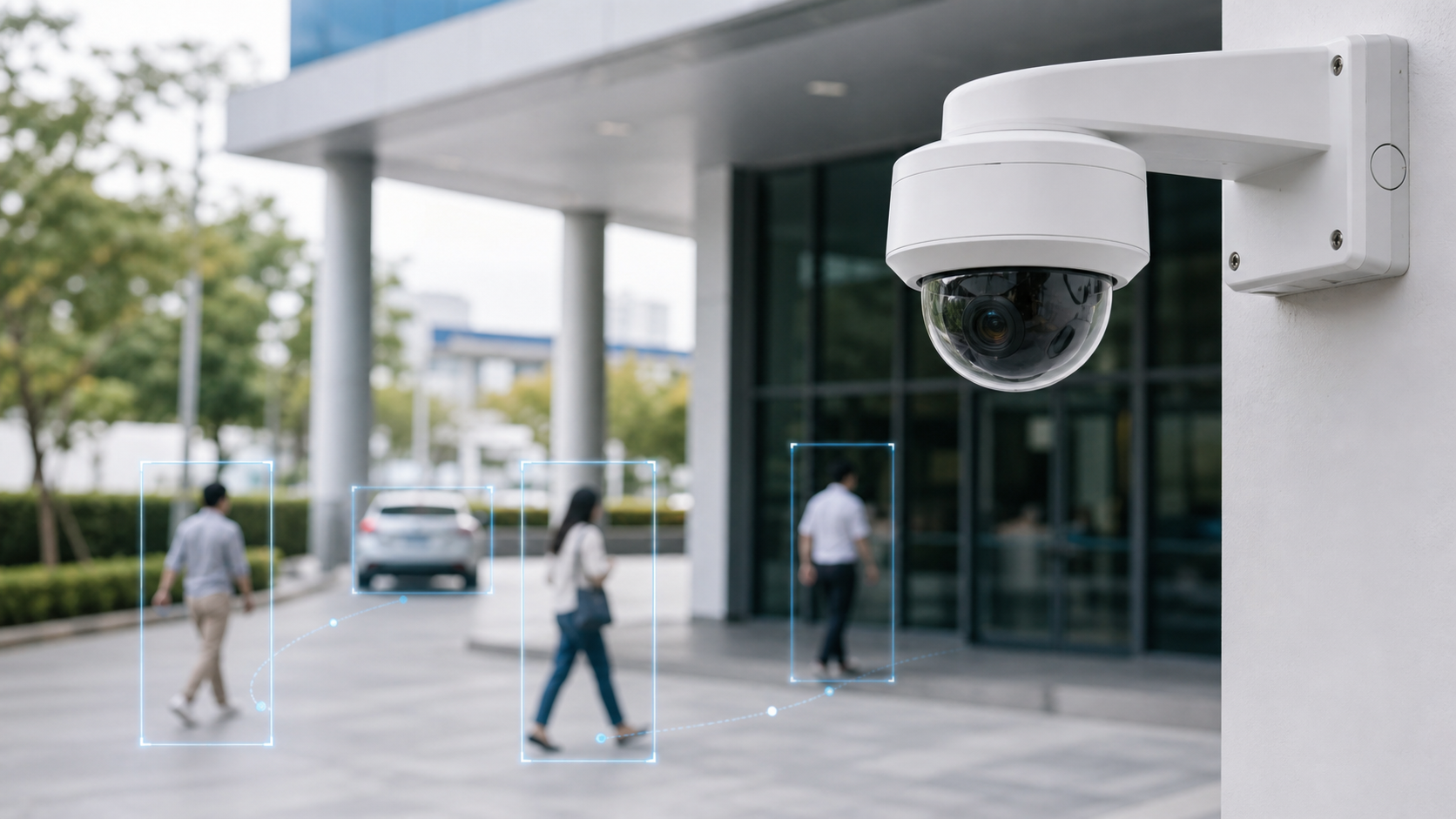
AI Video Analytics uses artificial intelligence to analyze CCTV footage, distinguish people, vehicles, objects, and defined events, then notify or send information to the responsible team in near real time. Many organizations can add this capability to their existing CCTV cameras without replacing the entire system, provided the current setup delivers suitable video quality and can connect to an analytics platform.
The result is that cameras no longer serve only to “record footage for later review.” They become assistants that filter important events, reduce the burden of continuous screen monitoring, and help operations teams make faster decisions.
AI Video Analytics is software that processes camera footage and uses Computer Vision models to detect, classify, and track activity within the image. Processing may run on an Edge device near the cameras, on an on-premises server, in the Cloud, or through a hybrid approach based on site constraints and data policies.
The system does not automatically “understand everything.” It operates according to defined objectives and rules, such as whether someone has entered a restricted area, whether smoke or flames are visible, whether employees are wearing the required protective equipment, or whether occupancy has exceeded a set threshold.
Conventional CCTV cameras capture, transmit, and record video. When an incident occurs, staff often need to review footage or monitor several screens at once. AI Video Analytics adds an analysis layer after the video feed is received, allowing the system to identify events that match specified conditions and forward only what requires attention.
The key difference is not simply “seeing movement,” but helping answer what happened, where it happened, and who should be notified.
The principle is to add an “analytics brain” to the current system without installing a new AI camera at every location. Video from existing cameras is delivered through an NVR, DVR, VMS, or the network to a processing device. AI then analyzes events and connects the results to the organization’s alerts or operating procedures.
Before deployment, the solution should be tested with the actual cameras and site conditions. Compatibility depends on the camera model, recorder, protocol, image quality, viewing angle, lighting, and network infrastructure.
Read more in How to turn existing CCTV cameras into AI cameras without replacing them
Capabilities should be selected according to business problems, rather than by the total number of available features. Common applications include:
Video detection should not replace every dedicated safety system, such as fire alarms or industrial sensors. It should work alongside those systems to add context and help verify events.
The short answer is that many existing cameras may work with AI, but each system must be assessed individually. IP cameras are generally easier to connect directly, while analog cameras may work through a DVR or encoder capable of providing a usable video stream.
The following areas should be checked before starting a project.
There is no single answer for every organization. Edge processing is suitable when low latency, operation during unstable internet connectivity, and local control of data are priorities. Cloud processing is useful for centralized management across several sites, flexible resource scaling, and remote system administration. Many projects use a hybrid approach in which Edge AI detects events immediately and sends only necessary information or event records to a central platform.
Accuracy depends on the use case, model, test data, and real operating environment. It should not be judged by one general percentage. Relevant measures include the rate of detected real events, false alerts, missed events, and the time between detection and notification.
A practical approach is to run a pilot using footage from the real site, define success criteria in advance, and involve frontline users before expanding the system. This allows camera angles, detection zones, thresholds, and workflows to be adjusted to the actual operating context.
Video may contain information that can identify individuals. Organizations should therefore design the system around Privacy by Design and applicable laws: collect only what is necessary, state the purpose clearly, restrict access, encrypt data, define retention periods, maintain activity logs, and provide appropriate notices in monitored areas.
If a use case does not require identity, organizations should prefer non-identifying functions—such as people counting or distinguishing people from vehicles—rather than using Face Recognition without a justified need.
Canal One developed ASAP (All Smart AI Platform) to connect CCTV, IoT, and an organization’s existing operational systems, adding detection, analysis, notification, and responses based on defined workflows. Its Smart Integration approach helps organizations begin with their current infrastructure, assess compatibility in the real environment, and select AI capabilities based on actual risks.
Rather than treating AI Video Analytics as only a camera replacement project, organizations can design it as an incident-management system that connects people, data, devices, and SOPs—from detection and response to using collected information for continuous improvement.
Making existing cameras smarter should cover both video analysis and routing detected events for team verification. An intelligent operations system should bring this information into an Integrated Operation Center (IOC) around the organization's actual workflow, retaining operator review and decision-making.
Many existing cameras can continue to be used.
If the cameras or recorders provide a supported video stream with suitable image quality, AI analytics and alerts can often be added without replacing the entire CCTV system. Compatibility should still be verified before deployment.
Alerts are delivered in near real time.
Actual response time depends on the AI model, number of cameras, processing hardware, network conditions, and the organization’s event-verification process.
Analog cameras may also work with AI.
A DVR or Video Encoder can convert the signal and provide a video stream to the analytics platform, provided the resolution and image quality are sufficient for the intended detection task.
Facial recognition is not required.
Many systems detect object types, behaviors, or events without identifying individuals. Face Recognition should be used only when there is a clear purpose, lawful basis, and appropriate data-protection measures.
AI supports staff rather than replacing operational judgment.
It filters events and prioritizes what requires attention, while people and clearly defined SOPs remain essential for verification, decisions, and incident response.
A pilot should begin with one representative risk area.
Start with a scope small enough to tune effectively but broad enough to reflect real conditions. Validate detection quality, notifications, and operational impact before expanding across the organization.
AI Video Analytics adds event analysis and filtering capabilities to a CCTV system. Many existing cameras can be upgraded by adding a compatible Edge Server, on-premises server, or AI platform, then connecting alerts to responsible teams and the organization’s SOPs.
The best starting point is not to ask, “How many features does the AI have?” but to select an important problem, evaluate the existing system, test under real site conditions, measure the results, and expand what has been proven. Organizations that want to assess how their current cameras and systems can work with AI can consult Canal One specialists to design a pilot suited to their actual environment.




We’re ready to help your team take the next step in safety, sustainability, and smart operations.