





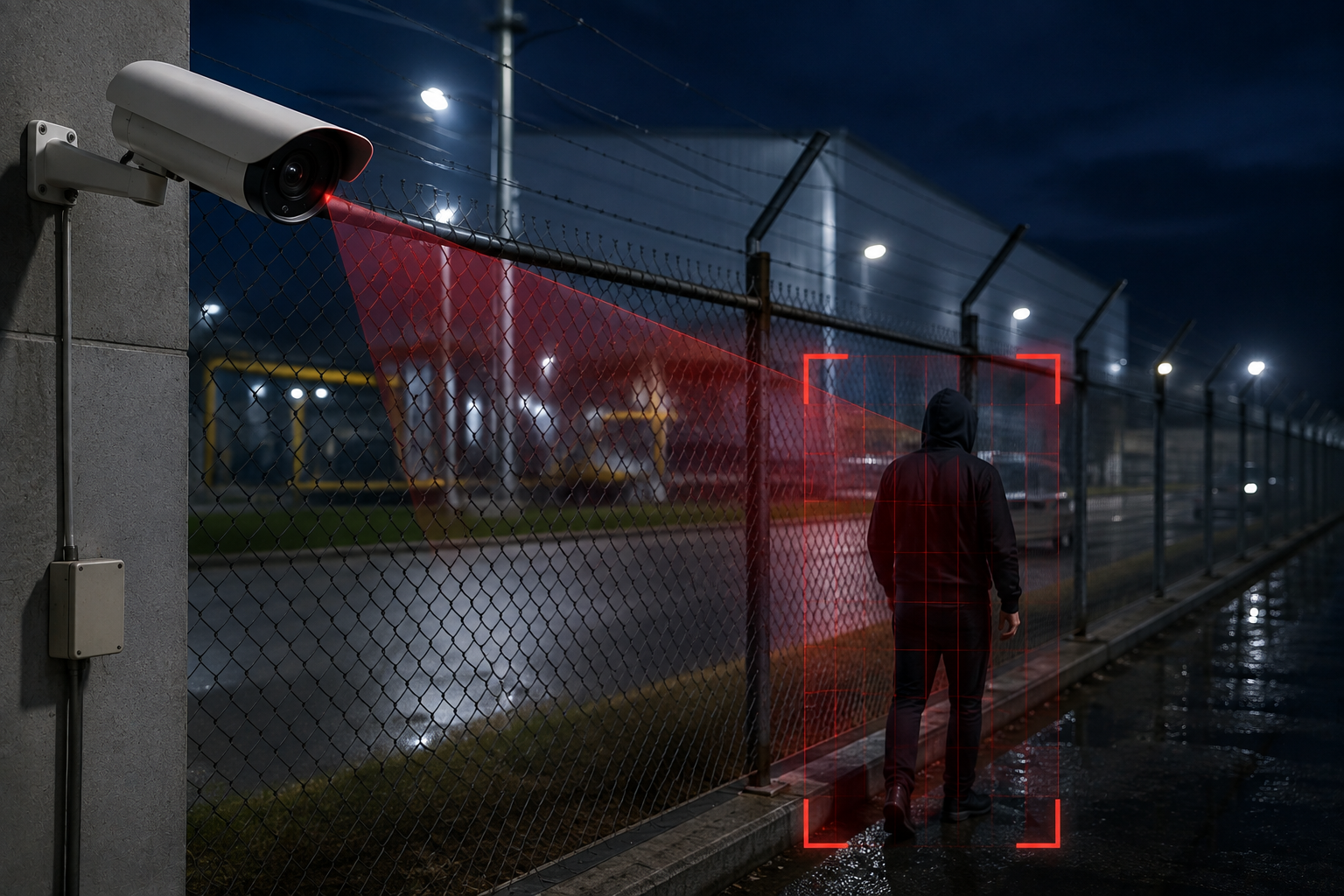
CCTV cameras can record someone entering a restricted area, but the more important question for modern security systems is: Can the system recognize that “this person is in an area where they should not be” and notify security personnel in time?
This is the role of AI Intruder Detection—a technology that uses AI Video Analytics to analyze CCTV footage and detect events that match predefined intrusion conditions within designated monitoring zones. Once detected, the event can be sent into an alert and review workflow for security personnel.
Within ASAP, or All Smart AI Platform by Canal One, Intruder Detection is one of the AI-Based Safety & Security Detection capabilities that can work alongside other functions such as Smoke and Fire AI Detection, PPE Safety, Face Recognition, License Plate Recognition, Path Track Technology, and Suspicious Object Detection to strengthen security analysis and alerting.
The key point is not simply that AI can “see a person.” The real value lies in turning CCTV footage into information that helps an organization identify events that require attention and deliver that information to the right people more quickly.
In simple terms, AI Intruder Detection uses AI to analyze images or video from CCTV cameras and help detect intrusion events according to predefined security conditions.
The difference from traditional CCTV lies in what happens after the camera captures the image.
In a conventional system, the camera sends footage to a monitor and records video. If someone enters an area they should not be in, a security operator must notice the event on screen or review the footage afterward.
The challenge is that large organizations may operate dozens or even hundreds of cameras. Expecting operators to continuously monitor every screen is difficult, and Canal One identifies this dependence on personnel as a key limitation of traditional systems because it can contribute to errors or delays.
When AI Video Analytics is added, the system can help analyze and filter events based on predefined conditions, directing the attention of security personnel toward situations that should be investigated.
Intruder Detection therefore does not replace security officers. Instead, it provides an additional layer of intelligence so that personnel do not have to rely solely on continuous manual screen monitoring.
The phrase “intruder detection” may suggest that AI needs to determine whether a person is “good” or “bad.” In the context of Video Analytics, however, the more important question is whether the event matches the predefined security conditions.
For example, an organization may want to closely monitor a perimeter fence, entrance, warehouse, or other critical area. When the system detects an event that matches the Intruder Detection conditions, that event can be turned into an alert for further review.
This is an important distinction between simply “seeing a person” and “detecting an event that requires attention.”
AI helps analyze visual information, while the design of the monitored area, detection conditions, and post-alert workflow must reflect the actual operating environment of each organization.
For this reason, an effective Intruder Detection system should not begin only with the question of whether AI can detect a person. It should begin with:
“Which area, what type of event, and at what time do we want the system to help monitor?”
When people think of AI CCTV, they often picture a rectangle appearing around a person on a monitor.
But in a real security system, drawing a box around an object does not mean the incident has been handled.
If AI detects an intruder but the alert remains only on a dashboard and no one receives the information, the detection may do little to improve the organization’s response.
This is why Real-Time Notification is another important part of the ASAP approach.
Canal One states that the system can support multiple alert channels, including LINE Official Account, Android/iOS applications, wired telephone, API, direct messages, strobe lights or sirens, and portable radios.
From an Incident Management perspective, the system should therefore be viewed as a continuous workflow:
CCTV → AI Detection → Alert → Human Decision → Response
When these components are connected, CCTV footage becomes useful not only for reviewing “what happened,” but also for helping security teams recognize that an event requiring investigation is happening right now.
In a small location with only a few cameras, manual monitoring may still be manageable.
But as the environment expands into a large factory, warehouse, data center, utility site, critical infrastructure facility, or outdoor perimeter with long fence lines, the challenge changes significantly.
More cameras mean more video data, but more data does not automatically mean security personnel can detect events faster.
If the system can help filter events that match abnormal or suspicious conditions, operators can focus on the locations and cameras that generate alerts rather than trying to monitor every feed with equal attention at all times.
This aligns with Canal One’s approach of using technology to improve efficiency, reduce the burden of people-dependent workflows, and lower the risk of Human Error.
The value of AI Intruder Detection therefore does not come from simply adding another feature to CCTV. It comes from helping shift Video Surveillance toward Video Intelligence.
Another important question for organizations is whether an existing CCTV system must be completely replaced with new AI cameras.
The answer is: Existing CCTV infrastructure may be able to work with AI Video Analytics, but the suitability of the infrastructure and use case must be evaluated first. It should not be assumed that every camera can immediately support Intruder Detection.
Canal One’s ASAP approach is designed so that AI can work with existing operational equipment, and the system design process begins by analyzing the user’s challenges, requirements, and infrastructure before customizing the solution for real-world use.
For Intruder Detection, this is especially important because even if a Video Stream can be connected to the AI system, the camera still needs to provide suitable visual information for the area being monitored.
A camera installed for general overview monitoring may not provide the detail or angle required for every use case. Camera position, environment, and monitoring zone all influence system design.
Therefore, before replacing every camera, organizations should first evaluate which existing cameras are positioned appropriately, whether the image quality meets the intended use case, and which areas should adopt AI first.
Intruder Detection becomes more useful when it is not isolated as a standalone system.
Imagine a factory at night. CCTV detects movement in a defined zone, AI analyzes the event and creates an alert, and the system sends a notification to the responsible personnel.
From there, the next steps can be designed around the organization’s Security Workflow.
Within the Canal One ecosystem, ASAP can work with other components such as CCTV, Integrated Communication Systems, Smart Voice Radio, Smart Drones, and Smart Robots. ASAP+ also supports Automation concepts such as deploying a drone to an incident location.
This means the role of a security system can go beyond AI simply saying, “An intruder has been detected.”
The goal is to create a Unified Security System in which Detection, Communication, and Response are systematically connected.
In some situations, security personnel may receive an alert and review additional footage before taking action. In large or difficult-to-access areas, other technologies may support further verification according to the workflow designed by the organization.
AI therefore does not necessarily replace human decision-making. It helps bring relevant information to decision-makers more quickly.
When discussing Intruder Detection, many organizations immediately ask, “How accurate is the AI?”
But evaluating the system based on a single percentage may not reflect real-world performance.
The effectiveness of Video Analytics depends on both the AI system and the quality of the visual data it receives, including camera position, viewing angle, environmental conditions, and the specific use case being monitored.
A system designed for one environment should not automatically be expected to perform identically in every situation without a site-specific assessment.
This is why Canal One places importance on analyzing user Pain Points and Requirements before applying technology, as well as customizing the system to work with Existing Infrastructure.
For organizations, the better question may therefore not be:
“Which AI is the most advanced?”
but rather:
“Has this system been designed for our location, our risks, and our workflow?”
When AI flags an intrusion, incident footage and location context should reach the team responsible for verification together. Designed around this context, an Integrated Operation Center (IOC) links incident information with responsible personnel through clear review and handover steps.
Many traditional security systems play an important role in preserving evidence. After an incident occurs, personnel can review CCTV footage to understand what happened.
AI Intruder Detection adds another dimension by helping detect an event while it is happening and feeding that information into the alert process.
This reflects a shift from Reactive Security, which focuses heavily on reviewing incidents after they occur, toward a more Proactive approach in which AI helps filter events and notify the right people sooner.
However, AI alone is not the whole solution.
A practical security system needs to connect cameras, data, alerts, people, and response workflows appropriately.
This aligns with Canal One’s approach of connecting People, Data, and Intelligent Devices through Seamless and Human-Centric technology, with ASAP acting as a platform that brings AI into the process of analyzing, detecting, and alerting on events.
So, if the question is:
“How does an AI Intruder Detection system work?”
The answer is not simply that AI watches CCTV footage and detects a person.
It is the process of analyzing camera footage according to predefined security conditions, identifying events that require attention, and connecting those detections to Alert and Response Workflows so that personnel can recognize, verify, and respond more quickly.
A smarter security system should not only record who entered an area.
It should help the organization recognize that an event requiring attention is happening while it is still happening.




We’re ready to help your team take the next step in safety, sustainability, and smart operations.