





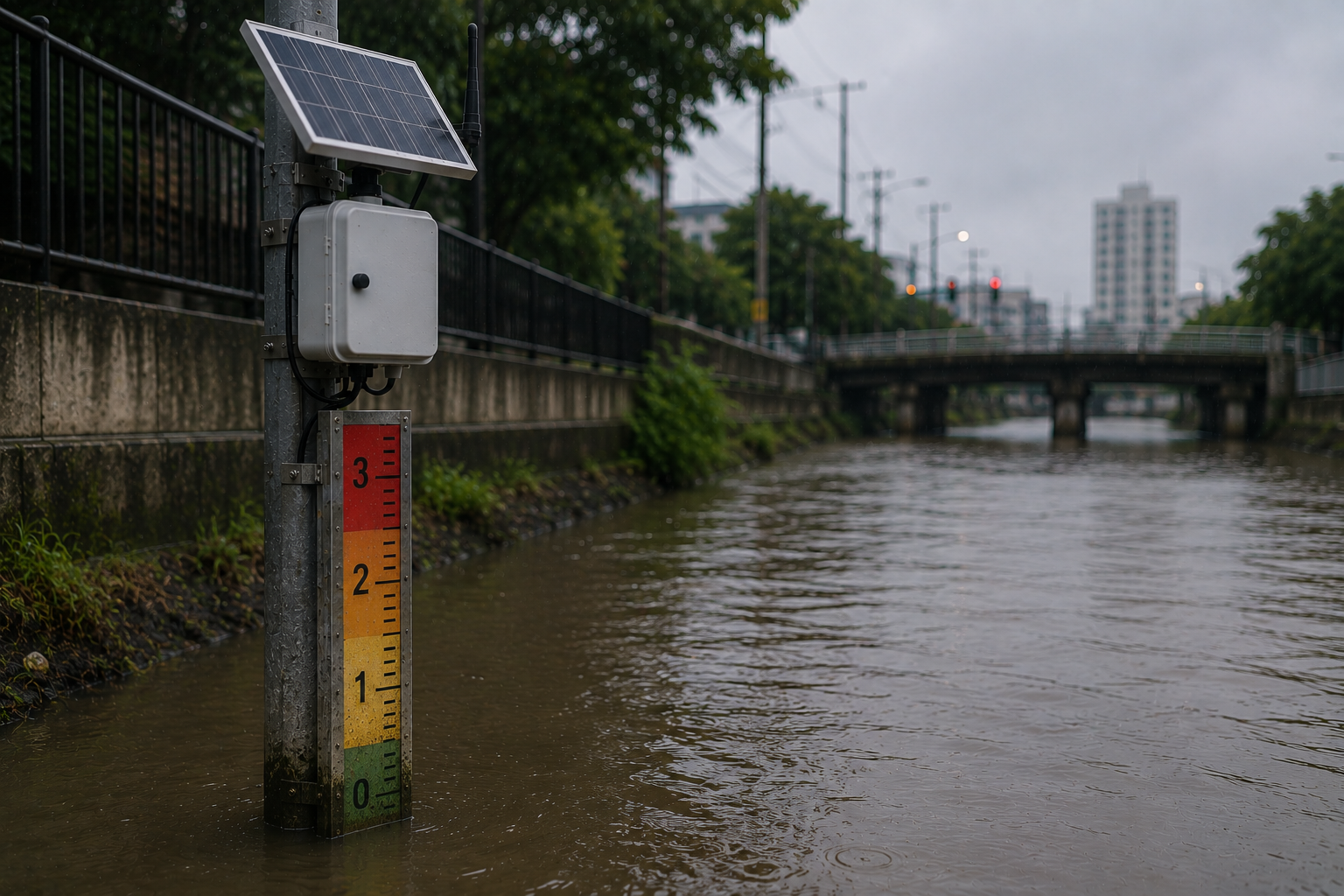
AI Flood Monitoring is an intelligent approach to monitoring water conditions by combining water-level data, connected sensors, AI, and management systems. It helps factories and cities monitor changing conditions, detect abnormalities, and deliver real-time alerts to responsible teams—enabling faster and more informed responses to potential flood risks.
For factories and large urban areas, flooding can affect far more than the locations where water accumulates.
Rising water levels can disrupt operational areas, transportation, infrastructure, assets, employee safety, and business continuity.
The key question is therefore not simply:
“Has flooding already occurred?”
But rather:
“Can we detect changing conditions early enough to respond?”
This is where AI, IoT, and Real-Time Monitoring can help transform traditional flood surveillance into a connected monitoring system that turns field data into actionable information.
AI Flood Monitoring is an approach that combines data from monitoring devices, such as Water Level Monitoring systems, with AI and centralized management platforms.
Instead of relying solely on personnel to inspect water levels manually, data from monitoring points can be transmitted to a centralized system, allowing responsible teams to monitor conditions remotely.
When data or events meet predefined alert conditions, the system can deliver Real-Time Notifications through appropriate communication channels and devices.
This creates a connected operational flow:
Monitor → Detect → Alert → Respond
The value of the system therefore goes beyond simply “measuring water levels.” It is about turning field data into information that supports faster decision-making and response.
One of the biggest challenges in managing factories, industrial estates, and cities is simple: people cannot be everywhere at the same time.
Large facilities and urban areas may contain numerous monitoring points across roads, operational zones, public areas, waterways, and other locations vulnerable to changing water conditions.
If monitoring relies primarily on manual inspection, there can be a gap between the moment conditions begin to change and the moment responsible personnel become aware of them.
Smart Monitoring changes this approach by allowing information from the field to come to the operator, rather than requiring the operator to physically visit every monitoring point.
When monitoring devices are integrated with IoT, AI, and notification systems, teams can monitor multiple locations through a centralized platform and receive alerts when conditions require attention.
Water Level Monitoring and Flood Monitoring are closely connected, but they are not exactly the same.
Water Level Monitoring focuses on tracking water-level data at specific locations.
Flood Monitoring takes a broader view by using this data as part of a larger process for monitoring flood conditions and managing potential incidents.
When water-level information is connected to a management platform, users can monitor conditions across different locations and use the data to support operational decisions.
The value therefore does not come from a sensor alone.
It comes from connecting:
Sensors + Data + AI + Alerts + Human Response
into a coordinated monitoring process.
For factories, flood monitoring can become part of a broader strategy for Safety, Environment, and Business Continuity.
This is particularly relevant for large industrial facilities where multiple areas may need to be monitored simultaneously.
A Flood Monitoring system can help operational teams monitor water-level information from critical locations through a centralized system rather than depending entirely on manual field inspections.
When conditions meet predefined alert criteria, responsible personnel can receive information more quickly and use it to support actions based on the organization's incident-response procedures or Standard Operating Procedures (SOPs).
The role of AI is not to replace human decision-making.
Its role is to help people see situations earlier, understand them faster, and make better-informed decisions.
A Smart Factory is not simply a factory that uses robots or automation on its production lines.
A truly intelligent factory should also be able to understand what is happening around its operational environment and use data to manage risk more effectively.
Flood Monitoring can therefore become part of a wider Smart Factory ecosystem alongside systems such as:
Water Level Monitoring for tracking water conditions.
Air Quality Monitoring for monitoring environmental air conditions.
Temperature Monitoring for tracking temperature changes.
Energy Management for monitoring and managing energy-related data.
Smoke and Fire AI Detection for supporting the detection of smoke and potential fire incidents.
When information from these systems can be integrated into a unified management environment, a factory can move beyond having multiple isolated devices toward Smart Integration that provides a clearer operational picture.
For cities, the challenge becomes even more complex because monitoring is not confined within a single facility.
A city may need to monitor multiple locations simultaneously, including roads, communities, public areas, waterways, and locations with a higher risk of rising water levels.
Connecting monitoring systems and field data to a centralized platform can help city operators monitor multiple locations more efficiently.
This information can also work alongside other Smart City data to provide a broader picture of conditions across an urban area.
One example is Rangsit City Municipality, which has utilized Canal One's technology for AI-powered Water Level Monitoring, Flood Monitoring, Traffic Density Analysis, and Intruder Detection through the Rangsit Smart City application.
This use case reflects an important principle of Smart City development: intelligent systems should not become isolated data silos.
Relevant information should be connected and made useful for more effective city management.
Data delivers the greatest value when it reaches the right people at the right time.
If a monitoring system detects changing conditions but responsible personnel receive the information too late, the value of that detection is significantly reduced.
This is why Real-Time Monitoring is an important part of an effective Flood Monitoring system.
Canal One's ASAP platform supports an On-the-Go Monitoring System, allowing users to monitor reports and events across devices such as smartphones, tablets, and monitors while tracking results in real time.
The system also supports Real-Time Notifications through suitable communication channels and devices.
The objective is straightforward:
Reduce the time between
“The system detects an event”
and
“The responsible person becomes aware of it.”
Detecting an abnormal condition is only the beginning.
The next question is:
What happens after an alert is triggered?
An intelligent monitoring environment should connect detection with the organization's incident-response process.
A typical flow can be viewed as:
AI / Sensor Alert → Incident Detail → Human Interaction → Response
Canal One's framework also allows automation to become part of the response process when appropriate. For example, ASAP+ can support automated actions such as deploying a drone to an incident location.
This means Flood Monitoring can evolve beyond being simply a “water-level dashboard.”
It can become part of an incident-management environment that connects data, people, and intelligent devices.
For many organizations, the problem is not a lack of technology.
The problem is that different technologies often operate separately.
Sensors may operate in one system.
CCTV may operate in another.
Alerts may come from another platform.
Environmental information may appear on another dashboard.
When an incident occurs, operators may have to move between multiple systems to understand what is actually happening.
Smart Integration aims to connect relevant information and devices so they can work together more effectively.
For Flood Monitoring, this means water-level information can become part of a broader view of Environmental Monitoring and Safety, rather than remaining isolated data.
This approach aligns with Canal One's broader strategy of connecting people, data, AI, and intelligent devices into a seamless operational experience.
ASAP, or All Smart AI Platform, is Canal One's management platform designed to enable AI to work alongside existing operational equipment.
The platform enhances the ability to analyze, differentiate, detect abnormal situation trends, and provide alerts across three core areas:
Safety Security Environment
Within Environmental Monitoring, relevant capabilities include Water Level Monitoring, Air Quality Monitoring, Temperature Monitoring, and Energy Management.
ASAP is also designed to work with an organization's existing infrastructure where appropriate.
Rather than beginning with the assumption that every existing system must be replaced, Canal One starts by analyzing the user's problems and requirements, then designs and customizes the solution to integrate with existing infrastructure.
For factories and Smart Cities, this changes the starting question from:
“What technology should we buy?”
to:
“What data and infrastructure do we already have, and how can we make them more useful for better decisions?”
When organizations think about AI for factories or Smart Cities, automation and security are often the first applications that come to mind.
However, AI and IoT can also play an important role in environmental management.
Water Level Monitoring is one part of this environment, alongside Air Quality Monitoring, Temperature Monitoring, and Energy Management.
Connecting these sources of information can help organizations move from reacting after a problem occurs toward more continuous environmental monitoring.
This supports a broader vision in which technology is not simply designed to make systems “smarter,” but also to make environments more responsive.
Canal One defines this as one of its key impact areas, alongside making people safer and businesses smarter.
Installing a sensor is only the beginning of an intelligent Flood Monitoring system.
What makes the system operationally valuable is how its components work together.
Monitor - Capture relevant information from the field.
Visualize - Make the information accessible to responsible teams.
Alert - Notify the right people when conditions require attention.
Integrate - Connect information with relevant systems and devices.
Respond - Use the information to support incident response and organizational procedures.
When these capabilities work together, Flood Monitoring evolves from a tool for “checking water levels” into part of a broader risk-management system.
Flood monitoring should connect water levels, vulnerable locations and area responsibilities so alerts support preparedness. An Integrated Operation Center (IOC) developed as a Smart IOC should connect this information with team verification and coordination, so awareness leads to an appropriate next action.
Flooding is a natural event that cannot always be prevented.
What organizations can improve is their ability to monitor, understand, and respond to changing conditions.
AI alone cannot stop a flood.
Sensors cannot make every decision for operators.
And a dashboard alone does not make a factory or city “smart.”
The real value emerges when:
Data + AI + IoT + People
work together as one connected system.
For factories, this can strengthen preparedness across Safety, Environment, and Operational Risk.
For cities, it can provide responsible teams with better visibility into changing conditions across multiple locations.
This reflects Canal One's human-first technology approach: intelligent systems should help make
People Safer. Businesses Smarter. Environments More Responsive.
Canal One AI and IoT Orchestration for Safety, Intelligence, and Seamless Innovation.




We’re ready to help your team take the next step in safety, sustainability, and smart operations.