





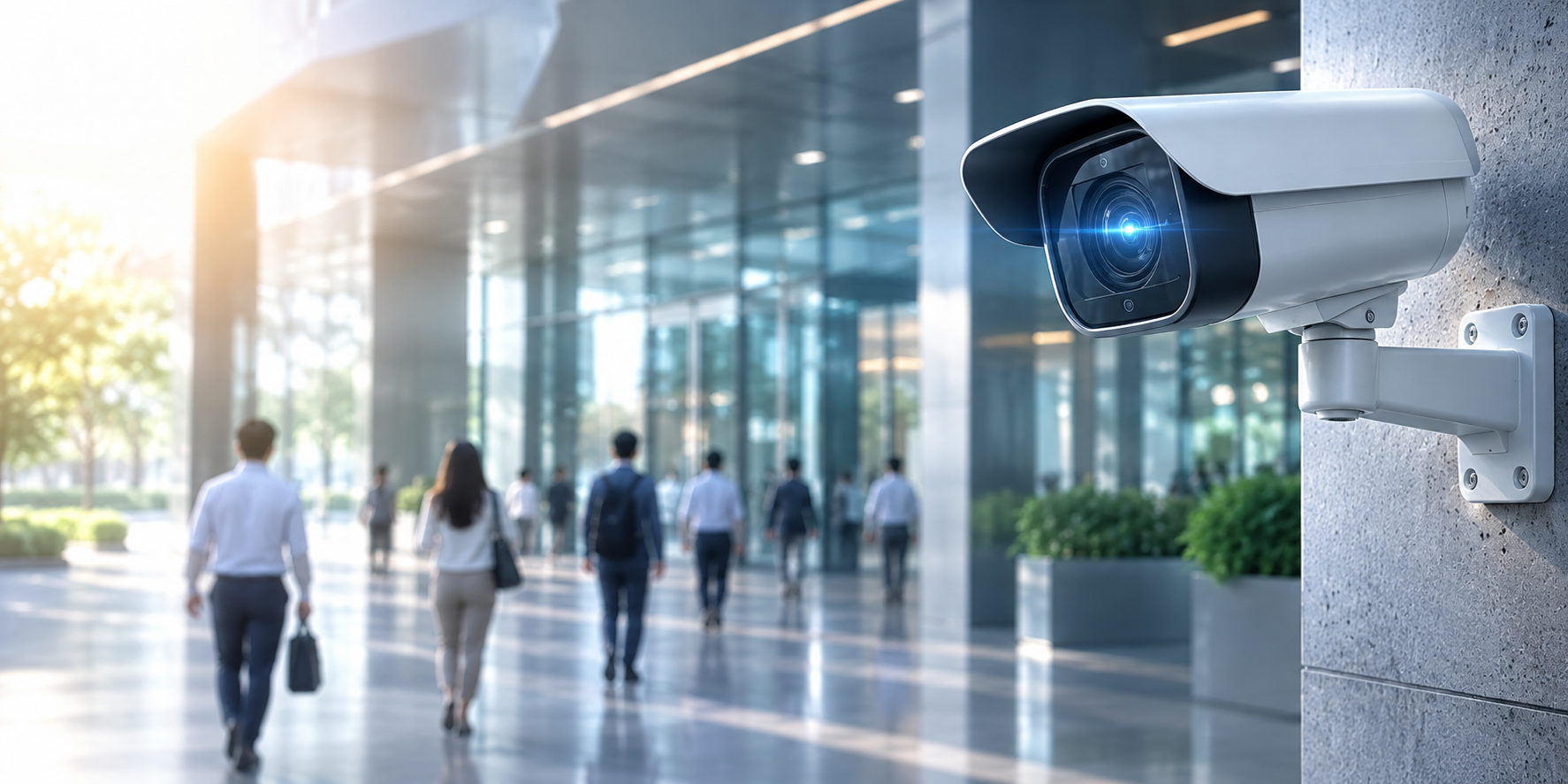
AI CCTV is a video surveillance system that uses Artificial Intelligence to analyze images and video in real time. Rather than merely recording events, the cameras can detect people, objects, behaviors, and unusual situations, then automatically alert the relevant teams.
For example, the system can detect intruders in restricted areas, verify PPE compliance, identify smoke or flames, count people, recognize license plates, and trigger alerts when an event matches conditions defined by the organization.
By connecting AI to existing surveillance cameras, organizations can transform CCTV from a tool used mainly for reviewing past footage into a proactive monitoring system that reduces risk and enables faster responses.
Traditional CCTV primarily records video and sends it to a recorder or control center. Operators must watch the screens manually or review footage after an incident to find evidence.
Although this type of system records events effectively, it has an important limitation: it cannot understand what is happening in the footage by itself. If no operator is watching, critical events may be missed, and reviewing historical footage can take hours.
In locations with many cameras—such as factories, warehouses, airports, office buildings, or smart cities—relying on people alone may not be enough. Human attention, fatigue, and the amount of information that can be monitored simultaneously are all limited.
The key difference is the ability to analyze events and respond to them.
Traditional CCTV requires operators to monitor screens, while AI CCTV can filter important incidents from large volumes of footage. Staff no longer need to watch every camera continuously.
AI CCTV can also categorize events, search footage by person, object, or time period, and generate statistical insights for security and operational analysis.
An AI CCTV system receives video feeds from cameras. An AI model then analyzes each frame to identify people, vehicles, objects, poses, and events.
When an event matches a defined condition—such as a person entering a restricted zone, an employee not wearing a safety helmet, or smoke appearing—the system creates an event and sends an alert to a dashboard, mobile phone, LINE Official Account, email, two-way radio, or another system through an API.
More advanced systems can also work with an organization’s workflows and SOPs—for example, activating an alarm, directing a PTZ camera toward the incident, switching on lights, or sending commands to connected devices.
Detects people entering restricted or designated areas during unauthorized hours and immediately alerts security personnel.
Checks for safety helmets, reflective vests, masks, and other personal protective equipment to support safety compliance in factories and worksites.
Analyzes video for early signs of smoke or flames, shortening detection time and improving the chance of controlling an incident before it spreads.
Detects falls involving employees, older adults, or people in high-risk areas and alerts the appropriate team to investigate.
Reads vehicle license plates, records entry and exit times, and integrates with gate-control systems or authorized-vehicle databases.
Counts people, analyzes crowd density, and tracks queue times. This is useful for shopping centers, events, airports, and public spaces.
Detects objects left unattended for extended periods or objects appearing where they should not be, supporting security operations.
Tracks the movement paths of people or vehicles to support incident analysis and faster searches of historical data.
Faster incident awareness The system can analyze events and send alerts within seconds, helping teams respond faster than waiting for someone to notice the incident.
Reduced operator workload AI filters footage from large numbers of cameras and highlights only significant events.
Less human error The system can monitor continuously, 24/7, without fatigue or loss of concentration.
More efficient video search Users can quickly search for incidents by person, vehicle, object, or time period.
Support for compliance and audits Event data can be used to generate reports, verify adherence to SOPs, and analyze risk trends.
Operational improvement through data Beyond security, people counting, queue analytics, and traffic-flow data help organizations plan resources and improve business efficiency.
Many organizations assume that adopting AI CCTV means replacing every camera. In practice, AI video analytics can often work with existing IP cameras and CCTV systems.
Organizations can route existing camera feeds to an AI server, edge AI box, or centralized platform to add analytics without investing in new equipment at every location.
However, performance depends on image quality, camera placement, viewing angle, lighting, and resolution. A site survey and real-world testing are therefore recommended before deployment.
AI CCTV can be used in factories, warehouses, office buildings, hospitals, schools, universities, shopping centers, hotels, airports, ports, government facilities, smart-city projects, and critical infrastructure.
In factories, AI CCTV helps monitor PPE, hazardous areas, fire and smoke, and behaviors that may cause accidents.
In buildings and commercial spaces, it supports intruder detection, people counting, queue analysis, and space management.
In smart cities, the system can connect cameras across many locations to monitor unusual incidents, traffic, flooding, and emergencies in real time.
AI CCTV accuracy does not depend on the AI model alone. It is influenced by camera resolution, installation angle, lighting, distance, object speed, and the real-world environment.
A well-designed system should be configured with detection zones, confidence thresholds, and alert conditions suited to each area, then tested in actual operating conditions before full deployment.
The goal of AI CCTV is not to replace every operator. It filters information and improves event detection so people can make faster, more accurate decisions.
Canal One developed ASAP (All Smart AI Platform) to connect existing CCTV cameras, IoT sensors, alert systems, smart drones, and other intelligent devices through a single platform.
The system supports real-time video analytics for safety, security, and environmental events. It alerts the relevant teams and connects response processes to the organization’s SOPs.
Most importantly, organizations can add AI capabilities to existing infrastructure without replacing every camera. This lowers investment costs, shortens installation time, and increases the return on existing CCTV investments.
Not always. Depending on the selected architecture, processing can take place on-premises or through edge AI within the organization.
It can in some systems, provided the analog video is converted and transmitted through a DVR or encoder that can supply a stream for analysis.
Generally, no. Existing cameras can be used if they provide suitable image quality and can send a video stream to the AI system.
False alarms are possible, but they can be reduced by configuring the model, detection zones, thresholds, and conditions for the actual environment.
It reduces the burden of continuously watching screens and helps staff manage events more efficiently, but people should still review and make decisions about critical incidents.
AI CCTV refers to camera systems with AI capabilities, while video analytics is the technology used to analyze video data—an essential component of an AI CCTV system.
The difference AI CCTV makes becomes clearer when detection connects with incident notification and handling. This is a practical context for an Integrated Operation Center: an intelligent, integrated situation-management center designed to connect information and coordinate the people responsible.
Unlike traditional CCTV, AI CCTV can interpret events, reduce human error, accelerate response times, and turn camera footage into actionable data for security and operations management.
For organizations that already have surveillance cameras, connecting existing CCTV to an AI platform adds value to the original investment without requiring an entirely new system.




We’re ready to help your team take the next step in safety, sustainability, and smart operations.