





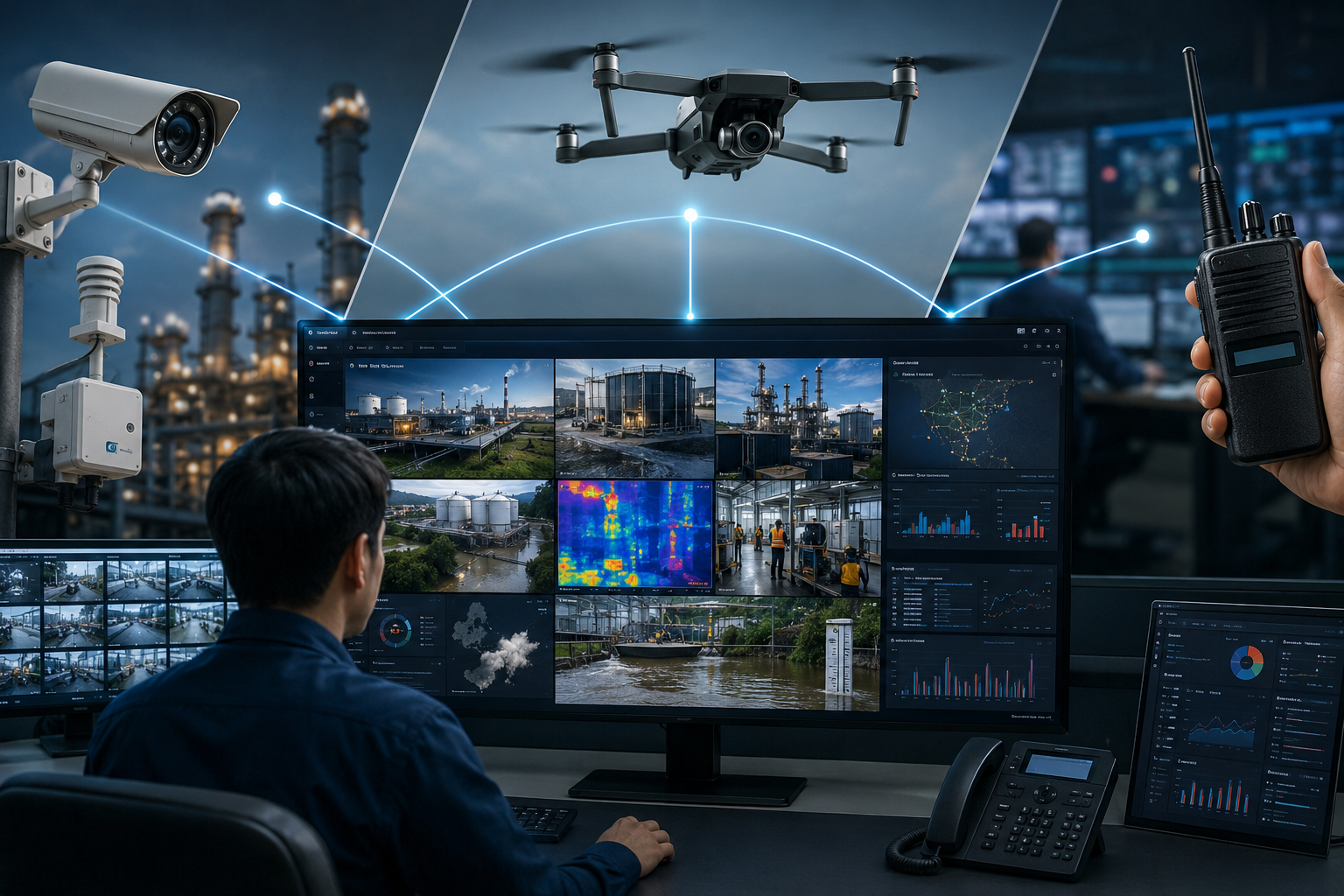
Today, many organizations already operate CCTV cameras, IoT sensors, drones, alert systems, and radio communication. The real challenge is often not a lack of technology, but the fact that these technologies still operate separately.
CCTV footage may appear on one screen, sensor data on another system, while incident response still depends on personnel noticing an abnormal event, assessing the situation, contacting the right team, and dispatching people or equipment to investigate.
When every step depends on separate systems and manual coordination, response can be delayed—especially across large industrial facilities, warehouses, critical infrastructure, and other environments that require continuous monitoring.
The next generation of security technology therefore goes beyond making CCTV “smarter.” It is about enabling multiple devices to detect, analyze, communicate, and respond as part of one connected platform.
This is the concept behind ASAP, or All Smart AI Platform, by Canal One—an AI-powered management platform designed to work with an organization’s existing equipment and infrastructure. ASAP enhances the ability to analyze data, distinguish events, detect abnormal situations and trends, and deliver alerts across Safety, Security & Environment operations.
Traditional CCTV plays an important role in surveillance and evidence recording. However, when an organization operates dozens or hundreds of cameras across multiple locations, personnel may still have to continuously monitor screens and determine which events require attention.
Integrating AI with CCTV changes the camera’s role from a device that simply “sees” into a source of information that helps the system understand what is happening.
ASAP can support AI applications across Safety and Security, including smoke and fire detection, PPE detection, intruder detection, face recognition, license plate recognition, path tracking, suspicious object detection, and staff counting.
But the real value is not simply what AI can detect.
The more important question is: What can the system do after an event has been detected?
In real-world safety and security operations, knowing that an incident has occurred is only the beginning. Reducing potential loss depends on how quickly an organization can transform that information into an appropriate response.
Not every operational or safety risk is visible through a camera.
Rising water levels, abnormal temperatures, air quality conditions, and energy-related data can all provide critical early signals. These conditions require sensors and IoT devices to measure what cameras cannot see.
ASAP is therefore designed to work with information from multiple types of devices rather than relying exclusively on CCTV.
Canal One applies this approach to areas such as Water Level Monitoring, Air Quality Monitoring, Temperature Monitoring, and Energy Management, as well as flood monitoring and other environmental applications.
When CCTV and IoT data become part of the same operational environment, teams gain a more comprehensive view of what is happening instead of manually switching between multiple independent systems.
This reflects the broader concept of AI and IoT Orchestration—connecting devices, data, and intelligent systems so that information can be transformed into actionable insights for decision-making and incident response. Canal One positions this integration of people, data, AI, and intelligent devices as a central part of its technology approach.
Imagine an AI system detecting unusual activity near the perimeter of a large industrial facility at night.
In a conventional workflow, a CCTV camera may capture the event, an operator notices it, security personnel are contacted, and someone is then dispatched to investigate the location.
When drones become part of an integrated platform, the response process can move further.
With ASAP+, automation can be used to control actions such as deploying a drone to an incident location. Canal One also presents Automated Security Drone Response as part of its security capabilities, allowing drones to become part of the investigation and response workflow rather than remaining standalone aerial devices.
A drone can provide additional visibility from the incident area, particularly across large sites, difficult-to-access locations, or environments where immediately sending personnel could create unnecessary risk.
In this model, drones do not replace security personnel. They extend the operational team’s visibility and ability to assess situations before or during a response.
No matter how quickly AI analyzes an event, effective security operations still depend on connecting information with the people responsible for making decisions and taking action.
This is why an Integrated Communication System and Smart Voice Radio can play an important role within a Unified Security System.
Canal One’s Real-Time Notification approach supports communication through different channels and devices, including LINE Official Account, Android and iOS applications, wired telephone, APIs, direct messages, strobe lights or sirens, and portable radios.
When AI detects an incident, the alert therefore does not have to remain on a dashboard inside a control room. Information can be delivered through communication channels appropriate to the organization’s operational workflow.
This matters because good technology should not create more steps for people. It should help important information reach the right people at the right time.
Consider an intrusion into a restricted area.
A CCTV camera captures unusual activity. AI analyzes the event and generates an alert. The information enters the operational management system. Relevant personnel receive a notification through predefined communication channels. If the system is configured for automation, a drone can also be incorporated into the investigation or response process.
What changes is not merely the speed of each individual device.
The entire incident workflow becomes connected.
Instead of CCTV, drones, sensors, and radios operating independently, an integrated platform allows them to become components of the same operational flow—from Detection and Alert to Human Interaction and Response.
This is the fundamental difference between owning multiple security technologies and operating a truly integrated security system.
One of the biggest concerns organizations have when considering AI adoption is whether they need to replace their existing infrastructure.
Canal One’s approach begins by understanding the user’s challenges, requirements, and existing infrastructure before designing and customizing a system that can integrate with what is already in place.
ASAP is designed to bring AI into existing operational environments, with the goal of creating a more seamless experience rather than simply adding another isolated technology stack. Canal One’s R4 company profile specifically describes ASAP as being able to work with an organization’s existing equipment.
For organizations, this is an important distinction.
Digital transformation does not always need to begin by replacing everything at once. It can begin by making existing devices and information work together more intelligently.
The value of AI Security & Safety is therefore not defined only by the number of AI features available.
Its value comes from connecting Detection, Data, Communication, and Response.
CCTV provides visual information. IoT sensors measure environmental and operational conditions. Drones extend visibility into physical spaces. Radio and communication systems connect information with field personnel. An AI platform can then act as the intelligence layer that helps analyze and coordinate these components.
As a result, personnel do not have to spend as much effort manually piecing together information from separate systems before understanding what is happening.
The same foundation can also support Compliance Monitoring. For example, AI can be used to monitor PPE usage or organization-specific operational requirements, helping security and safety systems contribute not only when an incident occurs but also to continuous risk and compliance monitoring. Canal One’s USP framework identifies AI-powered compliance monitoring, compliance alerts, customizable rules, and automated reporting as areas for this approach.
Many enterprise technologies offer powerful capabilities but are never used to their full potential because the systems are too complicated for everyday users.
Canal One therefore incorporates Human-Centric Design into its approach, combining User Experience Research with practical User Interface Design to create systems that are easier to understand and operate.
Users can monitor events through different devices, including smartphones, tablets, and monitors, while receiving real-time information according to the organization’s operational setup.
In Safety and Security environments, an easy-to-understand interface is more than a matter of visual design. It can directly influence how quickly people understand information and make decisions during an incident.
Connecting drones, cameras, sensors and radios should give field teams and the control center a shared incident picture. A comprehensive safety and security incident management platform working with an Integrated Operation Center (IOC) should connect essential information with the team's verification and response steps.
Many organizations already have CCTV. They may already operate sensors, radio communication, or even drones.
The most important question is therefore no longer simply:
“What technology should we buy next?”
A better question is:
How effectively can all our existing devices and data work together to help us detect, understand, decide, and respond?
Canal One approaches this challenge by connecting People, Data, and Intelligent Devices into a seamless operational environment. ASAP serves as an All Smart AI Platform that uses AI to analyze, detect, and alert, while CCTV, IoT devices, drones, and communication systems become connected components of the same operational ecosystem.
It represents a shift from security systems that depend on people to constantly watch for incidents toward systems that can help organizations detect, analyze, alert, and support coordinated response more systematically.
Because the goal of Smart Integration is not to give an organization more technology.
It is to make its technology work better together—so people can work more efficiently, operate more safely, and make faster, better-informed decisions.




We’re ready to help your team take the next step in safety, sustainability, and smart operations.