





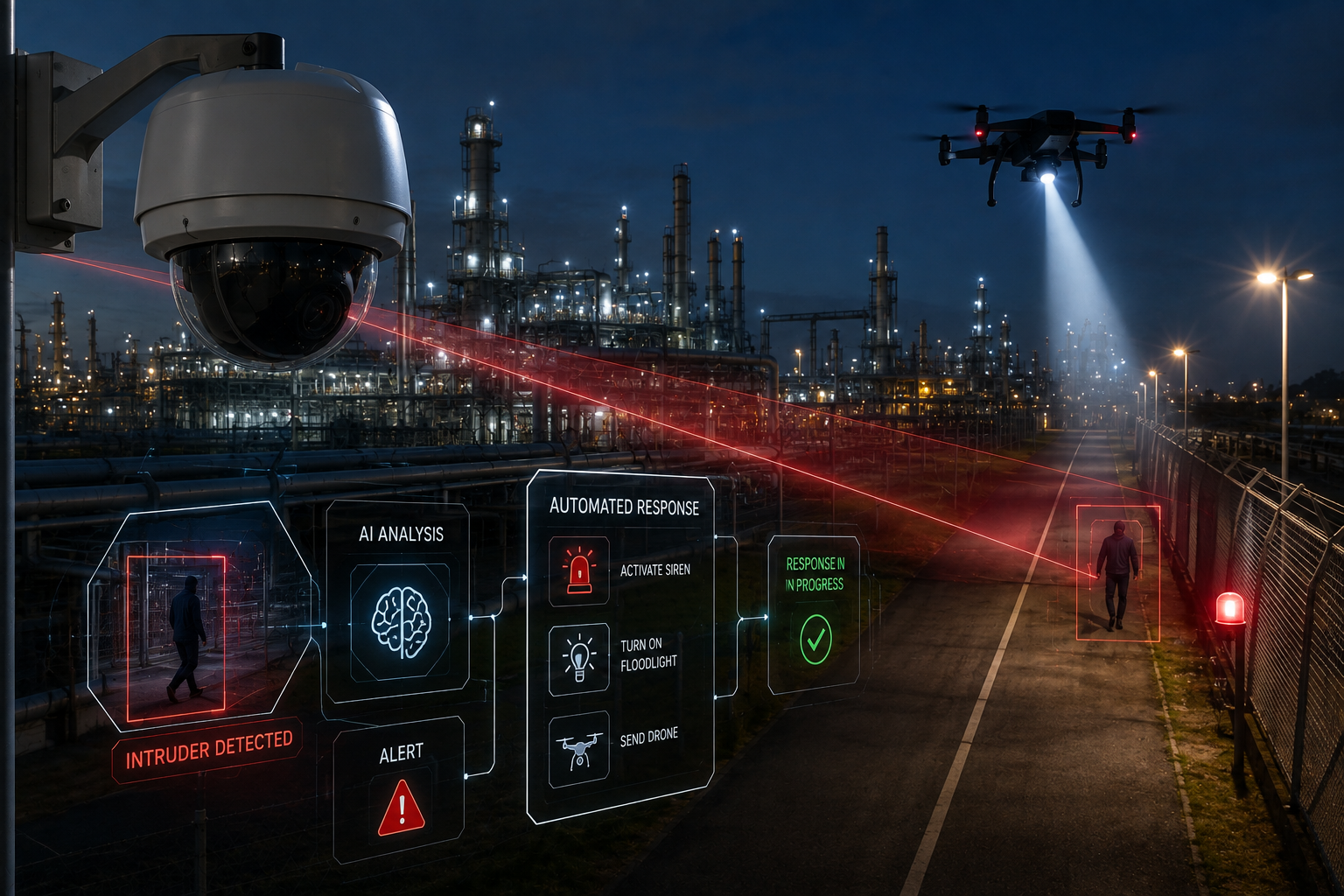
An alarm sounds. A warning light flashes. A notification appears on the screen. Does that mean the security system has already done its job?
The answer is: “Only part of it.”
Knowing that an incident has occurred does not necessarily mean that the incident is already being handled.
In a traditional Security & Safety system, several steps still need to happen after an alarm is triggered. Personnel need to notice the alert, review the information, assess what is happening, contact the responsible team, and decide what action should be taken next.
The more devices, locations, and communication channels a system has, the more important the gap between “Detection” and “Response” becomes.
This is why AI Automated Incident Response the use of AI and Automation to help initiate responses to incidents automatically—is becoming increasingly relevant to modern security systems.
For Canal One, this concept is extended through ASAP and ASAP+. ASAP provides capabilities for analyzing, classifying, detecting abnormal situations and trends, and generating alerts, while ASAP+ adds Automation capabilities such as automated device control or deploying a drone to an incident location.
The question, therefore, is no longer simply how to make a system “send alerts faster.”
It is how to enable the system to “start the response process faster.”
Imagine an intrusion at a factory during the night.
A CCTV camera or sensor detects an abnormal event and sends an alarm to the Control Room. An operator then opens the relevant footage, assesses the situation, contacts the security team, and dispatches personnel to the location.
The system has successfully generated an alert as designed, but the response that follows still depends on people across several steps.
This is not necessarily because personnel are inefficient. It is the nature of a Workflow that requires information to be gathered from multiple systems and coordinated across different teams.
Canal One identifies a key Pain Point in traditional systems: detection, data recording, and alert processes that rely heavily on personnel may contribute to errors or delays. Technology can help improve efficiency and reduce Human Error.
The limitation of a traditional Alert is therefore not that it cannot notify people.
The more important question is: After the alert is generated, how much more time passes before the response actually begins?
The key difference is Action.
An Alert system is primarily designed to let people know that something has happened. Automated Incident Response aims to connect Detection with the next actions defined within an established Workflow.
In simple terms, a conventional process may look like this:
Detection → Alert → Wait for Human Verification → Wait for Human Instruction → Response
Automation can help reduce some of those intermediate steps and create a more continuous process:
Detection → Analysis → Alert/Conditional Action → Human Verification and Further Response
Importantly, Automated Response does not mean that AI must make every decision instead of humans.
Human Decision remains essential in many situations, particularly when an incident requires context, risk assessment, or a high-impact decision.
The value of Automation is its ability to help manage Actions for which conditions and Workflows can be defined in advance, allowing relevant information and connected devices to begin operating sooner.
Automation becomes more useful when the system can distinguish between different types of events before initiating a response process.
If a system responds to every movement or alarm with exactly the same Action, it is not necessarily becoming more intelligent.
This is where AI Video Analytics plays an important role.
Canal One ASAP includes AI-Based Safety & Security Detection for different Use Cases, including Intruder Detection, Smoke and Fire AI Detection, PPE Safety, Suspicious Object Detection, Face Recognition, and License Plate Recognition.
AI can therefore become part of a process that helps classify whether information from CCTV or another detection system corresponds to a particular type of event before passing it into the appropriate Alert or Workflow.
As a result, a Security System does not have to treat every incident in the same way.
An intrusion may require one Workflow, while Smoke and Fire Detection may require another. A Compliance Event may need to be routed to a completely different responsible team.
This represents a shift from One Alert, One Reaction toward designing responses that better correspond to the type of incident detected.
A drone provides a clear example of the difference between an Alert and an Automated Response.
If CCTV detects an abnormal event across a large site, a traditional system may send an Alert to personnel. An operator then needs to verify the location and decide whether a team should be dispatched.
When Automation is connected to the Workflow, however, certain steps can begin automatically according to predefined conditions.
Canal One states that ASAP+ extends ASAP with Automation capabilities and can be used to control automated devices, such as deploying a drone to an incident location. Automated Security Drone Response is also presented as one of Canal One's Security Solutions.
For large sites or locations that are difficult to access, this means a drone does not have to remain a separate device that requires an operator to manually initiate every mission. It can become part of the Incident Workflow.
The meaning of “Response” therefore changes.
The system does not stop at saying:
“An incident has occurred here.”
Instead, it can be designed to initiate relevant Actions according to the conditions defined by the organization.
In Security & Safety operations, time matters.
A system may detect an incident very quickly, but if the information has to move through multiple screens, systems, or people before a Response begins, some of the value of rapid detection may be lost.
Automated Incident Response is therefore valuable not simply because it is “automated.”
Its real value lies in helping reduce the Response Gap between the moment the system recognizes an event and the moment the response process begins.
The clearer the Workflow, the more effectively the system can help deliver information through the appropriate channels or initiate predefined Actions in a continuous process.
ASAP supports Real-Time Notification through channels such as LINE Official Account, Android/iOS applications, wired telephone, API, direct messages, strobe lights or sirens, and portable radios.
When these notification channels work together with Detection and Automation, the system goes beyond simply having “AI detect an event and send a message.”
Instead, it connects:
Detection → Analysis → Communication → Action → Human Response
One common misconception about automated AI incident response is that AI is intended to replace security personnel or system operators entirely.
A well-designed system should use Automation where it helps people work faster and access relevant information more efficiently—not remove humans from the process where human judgment remains necessary.
Some Actions can be predefined, while other decisions should remain with responsible personnel.
For example, a system may detect an incident, notify the appropriate team, display relevant camera information, or initiate a predefined verification process. Personnel can then assess the situation and make critical decisions.
This approach aligns with Canal One's Human-Centric Design, which emphasizes designing technology around human needs and real-world usage, including UX/UI that makes important information easier for users to access.
Good AI is therefore not AI that simply “removes people.”
It is AI that helps ensure people do not have to spend valuable time on steps the system can help manage.
Even a highly capable AI system may not be enough if CCTV operates in one system, drones in another, radios are separate, and IoT Sensors use an entirely different Dashboard.
Every time information has to be manually transferred from one system to another, the Workflow still contains potential points of delay.
This is why Smart Integration and a Unified Security System are important for Automated Incident Response.
Canal One positions ASAP to work with a range of components, including CCTV, Smart Drones, Smart Robots, Integrated Communication Systems, Smart Voice Radio, and Advanced Thermal Sensors, supported by an AI & IoT Orchestration concept that connects People, Data, and Intelligent Devices.
When these technologies operate as part of the same Ecosystem, an incident can move more systematically from a Sensor or CCTV feed to AI, from AI to Notification, and from Notification or Automation into Response.
This is the difference between having “multiple security devices” and having “a security system in which those devices work together.”
Automation should not be interpreted to mean that whenever AI detects something, the system must immediately activate a device or initiate the same response.
An effective system needs to be designed around the risks and context of each organization.
Some incidents may require immediate notification. Others may require Verification before further action. Certain Workflows may be connected to Automation only after predefined conditions have been met.
Designing Automated Incident Response should therefore begin with a simple question:
“When this event happens, what does the organization want to happen next?”
From there, the organization can determine which Actions should be Automated Actions and which should require Human Decision.
This aligns with Canal One's approach of first analyzing the user's Pain Points, Requirements, and Existing Infrastructure before customizing the system for actual operational needs.
Technology should not dictate the Workflow.
Instead, the organization's Workflow should determine how technology is used.
Automated response should show teams which actions have started and where an operator still needs to decide. An Integrated Operation Center (IOC) developed as a Smart IOC should connect this information with team verification and coordination, so awareness leads to an appropriate next action.
Many traditional security systems are designed effectively for recording evidence and generating alerts.
AI and Automation add another level of capability to the Security System.
Instead of the system simply saying:
“Something has happened.”
It can evolve toward helping determine:
“What type of incident is happening?”
That can then lead to an even more important question:
“What should the system begin doing next?”
This represents a shift from Reactive Security toward a more Proactive Security approach.
However, the goal is not to automate everything simply for the sake of Automation. The goal is to apply Automation where it can help reduce the time between Detection and Response, reduce repetitive tasks, and help critical information reach decision-makers sooner.
For Canal One, this concept is reflected in the integration of ASAP, AI Security & Safety, Real-Time Notification, Smart Integration, and Canal One's Automation capabilities, allowing AI to become more than a system that simply “sees” or “alerts.” It can become part of the Incident Management Workflow.
So, if the question is:
“Why is AI Automated Incident Response better than traditional alerts?”
The answer is not that Automation can replace people entirely.
It is because an Alert tells us that an event has occurred, while Automated Incident Response can help the next stage of the process begin faster and more continuously according to conditions and Workflows defined by the organization.
In Security & Safety, detecting an incident quickly is important.
But equally important is this:
Once the system knows that an incident has occurred, how quickly can it begin doing something about it?




We’re ready to help your team take the next step in safety, sustainability, and smart operations.