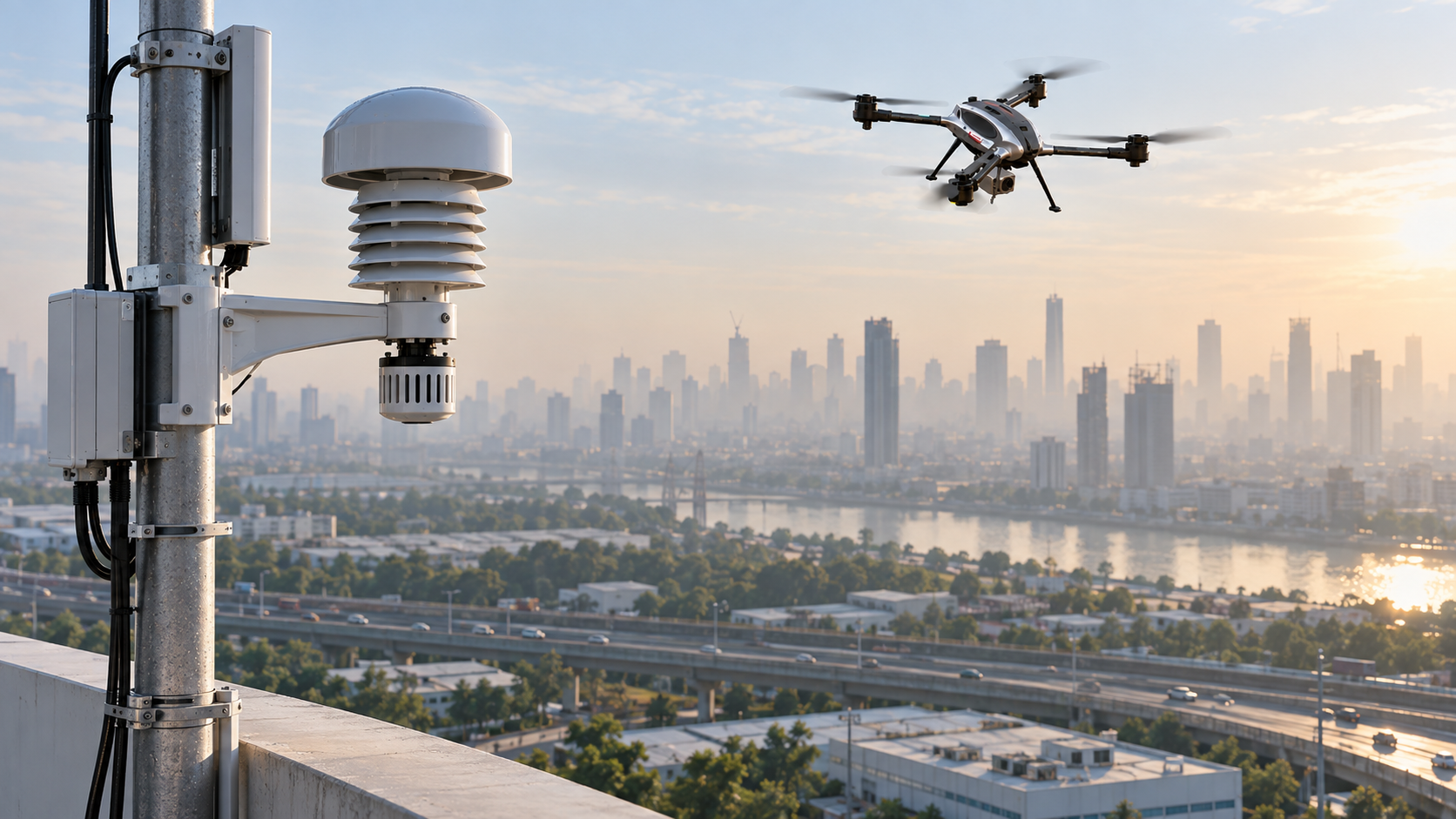
The PM2.5 problem doesn’t occur only “in Bangkok’s winter,” and it’s not uniform across an entire city.
It changes hour by hour – and can be different from one side of the street to the other.
For factories, schools, hospitals, and urban districts that must make decisions in real time, relying solely on centralized, aggregated data is often “one step too late.”
The answer is to put an “intelligent brain” on-site – using AI Air Monitoring so you can know first, warn first, and trigger automatic actions through Canal One’s ASAP Platform.
Why PM2.5 Needs “AI Air Monitoring” – Not Just Basic Sensors
- Real-time visibility + trend prediction
AI analyzes wind direction, environmental context, and on-site behavior → so you know “when levels are about to spike,” not just what the number is right now. - Covering blind spots (micro-hotspots)
You can deploy multiple units across a plant or community to build a risk heatmap, revealing true critical areas rather than relying on a single average value. - Edge-first, not dependent on the internet
Processing happens directly on the device in the field, reducing delay and cloud dependence – and alerts continue even when connectivity is unstable. - Extends into automatic actions
Link to SOP Automation such as:- Closing fresh air dampers
- Increasing HEPA filtration
- Sending alerts
- Issuing mask distribution notices
- Postponing outdoor activities
- Transparent and auditable
Log events, responses, and responsible parties for immediate compliance and ESG reporting.
ASAP Platform for Air Quality: Detect – Alert – Act in One System
ASAP (All Smart AI Platform) connects:
- Air quality sensors
- CCTV
- PA systems
- Radios
- Mobile apps
- Digital signage
- BMS/HVAC
- Other data sources
…so that people, data, and devices can work together as one team.
Key Capabilities
- Sensor Fusion & AI Scoring
Combine dust/gas/temperature/humidity readings with local context to produce a reliable risk score. - Predictive Alerts
Define multiple thresholds (Advisory / Warning / Critical) and send alerts via:- Mobile
- LINE OA
- Radios
- Sirens/strobes
- APIs
- Automatic SOPs
Link conditions → actions, such as:- Opening/closing dampers
- Increasing filter cycles
- Pushing automatic public announcements
- Unified Security System
Merge environmental monitoring with physical and cyber security into a single view, reducing silos and duplicate work. - Edge + Green Tech
Reduce bandwidth and energy consumption by processing near the data source using energy-efficient devices.
High-Impact Use Cases in Thailand
- Factories / warehouses
Control loading bays, spraying/welding/painting zones to lower workers’ dust exposure, with built-in compliance monitoring and audit evidence. - Schools / universities
Automatically switch activities indoors when thresholds are exceeded, and notify parents/teachers via LINE OA. - Hospitals / public buildings
Connect BMS/HVAC so the system automatically strengthens air treatment when PM2.5 levels rise. - Smart cities / municipalities
Use AQ heatmaps to decide when to:- Close or reroute roads
- Manage hotspots (burning/particle sources)
- Communicate with residents at a hyperlocal level
How to Start (5-Step Roadmap)
- Set goals & KPIs
- How many minutes do you want to cut between “PM spikes” and “alert sent”?
- How many worker exposure hours do you want to reduce?
- Map risk points
- Production zones, intake towers, loading yards, playgrounds
- Plan sensor placement in phases.
- Connect to ASAP
- Use API/Universal Connector to connect sensors, PA, radios, digital signage, BMS/HVAC into one platform.
- Define thresholds & SOPs
- Set Level 1–3 alerts, channels, and measurable automatic actions.
- Drill and refine the model
- Test in real conditions (morning/evening/burn season), adjust thresholds and risk zones, and report results quarterly.
Frequently Asked Questions (FAQ)
How is AI Air Monitoring different from a normal AQI display?
Traditional systems mostly “report history,” while ASAP’s AI can “predict and act automatically” – for example, adjusting filtration, notifying staff, moving activities indoors – and log both the event and response for audits.
If the internet goes down, can it still alert?
Yes. With an Edge-first architecture, processing and alerting happen at the sensor point, so the system can still send signals via local devices even when the internet is unstable.
Do we need to replace all our sensors?
Not necessarily. ASAP supports multi-brand / multi-protocol and can connect your existing sensors first, then gradually add new nodes as budget allows.
Is personal data safe?
We follow Privacy & Security by design with:
- Configurable compliance rules and access control
- Audit trails of decisions
…all aligned with organizational policies and relevant regulations.
PM2.5 readings should connect with measurement locations and building teams so air-quality alerts become actionable. Designed around this context, an Integrated Operation Center (IOC) links incident information with responsible personnel through clear review and handover steps.
AI + Air = Faster Decisions, Real Impact Reduction
Effective PM2.5 management starts with “knowing in time” and “acting immediately.”
The ASAP Platform turns AI Air Monitoring into more than just number-watching – it becomes a proactive protection system that connects people, data, and devices to work as one team.